You have spent months developing a product. The shape is distinctive, the mechanism solves a problem, and you have finally settled on a brand name. Before putting it on the market, there is one question worth answering: what exactly can you protect?
“Register the idea” sounds simple, but intellectual property does not work that way. A product’s appearance, technology, branding and creative content fall under different legal rights. Protecting one part does not automatically protect the rest.
Understanding the difference between design and patent, along with where trademarks and copyright fit, helps you make better decisions before launch. This guide explains the four options in the Indian context, using examples you can relate to.
What Is the Difference Between a Design and a Patent?
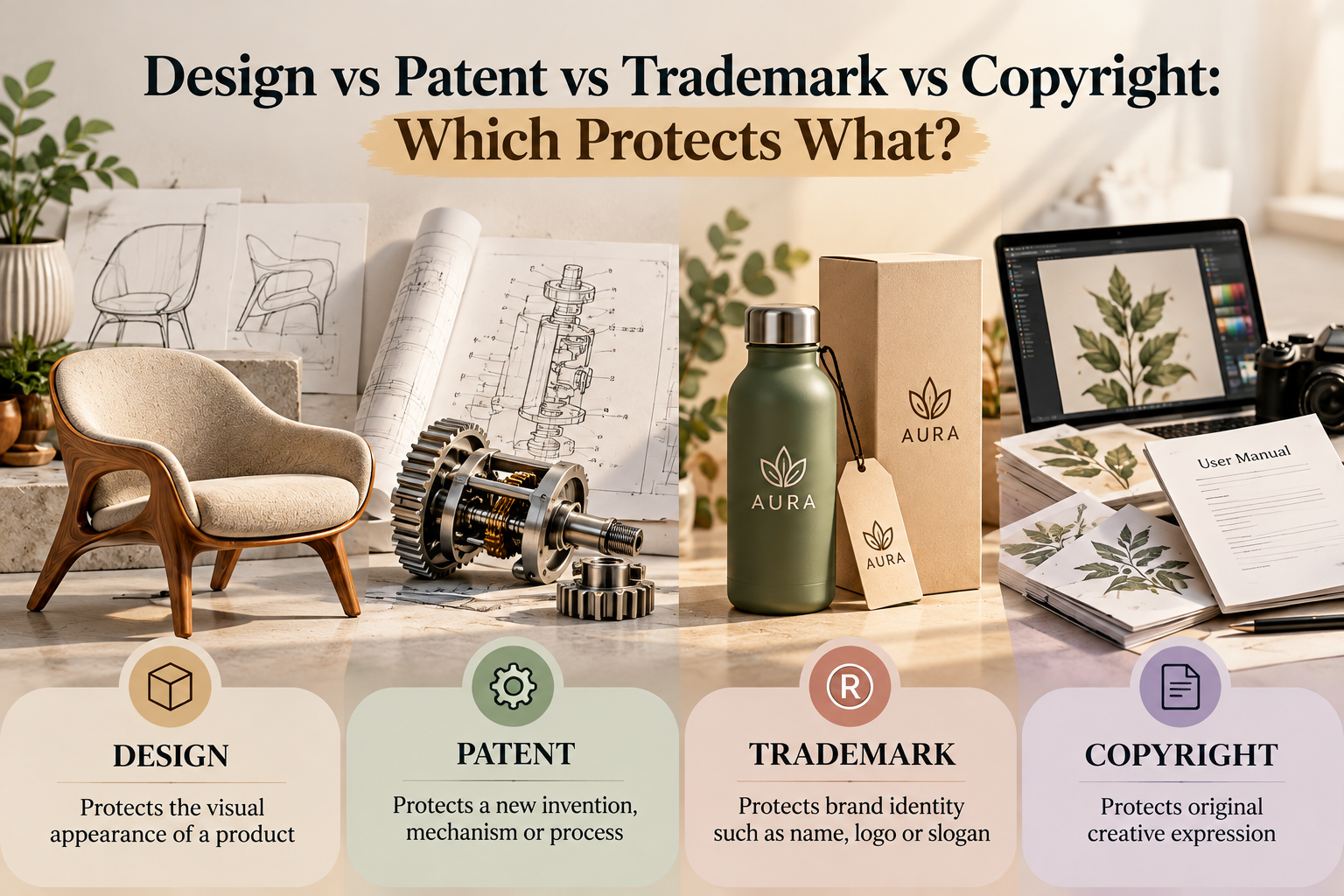
A registered design protects the eligible visual appearance of a product. A patent protects an eligible invention, such as a new product, mechanism or process.
Take a table lamp. Its sculpted base and ornamental shade may qualify for design registration. If it also contains a new lighting mechanism that meets India’s patentability requirements, that invention may qualify for a patent.
The distinction comes down to the feature you want to protect:
- Design: What does the product look like?
- Patent: What technical invention does it contain?
There is a point here. A product that looks good does not automatically get design registration and an improvement that works well does not automatically get a patent. Every application has to meet its legal rules.
The same product can potentially have both protections, provided they cover eligible features.
What Does Each Right Actually Protect?
These rights can work together, but they are not interchangeable. Here is what each one does.
Industrial Design: Protecting Product Appearance
Design registration concerns new or original visual features applied to an article through an industrial process and judged by the eye.
These features can include:
- Shape and configuration.
- Patterns and ornamentation.
- Compositions of lines or colours.
- Combinations of these elements.
For example, a furniture business may develop a chair with a distinctive ornamental silhouette. A homeware brand may create a new decorative pattern for its dinnerware.
Those features may qualify for protection under the Designs Act, 2000. However, design registration does not protect a construction principle or a feature that is essentially a mechanical device.
If the commercial value lies in the product’s appearance, industrial design registration is a route worth assessing before launch.
Patent: Protecting an Eligible Invention
A patent concerns an invention rather than appearance alone. In India, an invention generally needs to be:
- Up-to-Date.
- Inventive rather than an obvious modification.
- Capable of industrial application.
- Outside the statutory exclusions from patentability.
Think of a way to filter something or a new way to make a product that fixes a tricky problem in a surprising way.
The patent that is approved says what is protected. This means the way the application is written and how much it covers matters: just explaining a machine doesn’t always mean you own every single part of it.
Companies that are making products should check about patent registration before they show the invention, to the public.
Trademark: Protecting Brand Identity
A trademark helps customers recognise whose goods or services they are choosing.
It may protect eligible signs such as:
- A brand name.
- A logo.
- A distinctive slogan.
- Certain product or packaging shapes.
Imagine two companies selling water bottles. The name and logo help customers tell one business apart, from the other. That is where trademark protection becomes important.
A trademark does not automatically protect the bottle’s technology or its decorative appearance. Its main job is to protect the business’s identity.
Copyright: Protecting Creative Expression
Copyright protects qualifying original expression. Examples include:
- Written content and instruction manuals.
- Illustrations and photographs.
- Computer programs.
- Music, films and sound recordings.
For instance, someone may copy your original product photographs without copying the product itself. That can raise a copyright issue.
Copyright generally arises automatically when a qualifying work is created. Registration is optional, although it can provide useful evidence in a dispute.
It protects expression, not the general idea behind it. Writing down an idea for a fitness app does not give you copyright over every app offering that concept.
Examples of the Difference Between Design and Patent
Let us look at how these rights might apply to everyday businesses.
Example 1: A Reusable Water Bottle
Suppose you create a bottle with an unusual exterior and a new leak-prevention mechanism.
Different parts may need different protection:
- Design: Its eligible ornamental shape.
- Patent: The leak-prevention invention, if it qualifies.
- Trademark: The brand name and logo.
- Copyright: Original packaging artwork, photographs and written instructions.
Now imagine a competitor uses a different name but copies the bottle’s appearance. Your brand-name trademark may not address that problem. The relevant design rights would need to be considered.
The right question is therefore: “Which part might someone copy?”
Example 2: A Printed Fabric Collection
A textile studio takes an illustration and turns it into a repeat pattern, for fabric.
On the surface this looks like a copyright issue. When the artwork is used on products that are made for sale design law might come into play.
Before production, the studio should check:
- Whether the applied pattern qualifies for design registration.
- Whether it has already been publicly disclosed.
- Who owns the original artwork.
- How industrial reproduction affects the available protection.
This is especially useful for businesses producing textiles, wallpaper, decorative packaging or patterned homeware.
Example 3: A Mobile App
An app may contain several distinct assets:
- Its name and logo may qualify for trademark protection.
- Original code and graphics may receive copyright protection.
- Promotional videos and written content may also receive copyright protection.
Patent protection needs its separate evaluation. Under law computer programs by themselves are not eligible, for patents. So just because an app has a feature it does not automatically qualify for patent protection.
Design vs Trademark: Is the Value in the Look or the Brand?
The design vs trademark distinction is easiest to understand by looking at why customers recognise a product.
A design concerns eligible visual appearance. A trademark identifies the business behind the goods or services.
Consider a perfume bottle:
- Its ornamental shape may qualify for design registration.
- The perfume’s name may qualify for trademark registration.
- Its logo may qualify separately as a trademark.
Some product shapes can potentially function as trademarks. However, specific exclusions apply, including shapes necessary to obtain a technical result or shapes giving substantial value to the goods.
A design registration does not reserve your brand name. Likewise, registering your name does not automatically protect your packaging’s ornamental features.
For a product-led business, both may deserve attention.
What Happens When Artwork Goes Into Production?
The design vs copyright question often catches businesses by surprise.
You might assume that because you created an illustration, copyright will protect every commercial application of it. Indian law draws a more careful distinction.
Section 15 of the Copyright Act, 1957 provides that:
- Copyright under that Act does not subsist in a design registered under the Designs Act.
- For an unregistered design capable of registration, copyright in that design ceases once articles carrying it have been reproduced more than 50 times through an industrial process by the owner or someone acting with their licence.
That is not a general “50 copies” rule for all artwork. It concerns registrable designs and their industrial application.
Whether the underlying artistic work retains separate protection depends on the circumstances. The original illustration and the design applied to an article should not simply be treated as identical legal assets.
If you plan to manufacture products carrying original artwork, review this overlap before production begins.
Which Protection Should You Consider?
You do not have to start with legal terminology. Start with what you have created.
Step 1: Identify the Feature You Want to Protect
Follow the route that matches the asset:
- A technical invention: Assess patent eligibility.
- A new product appearance: Assess design registration.
- A brand name or identifying sign: Assess trademark protection.
- Original creative content: Assess copyright protection.
If several descriptions apply, you may need more than one route.
Step 2: Check Whether It Has Been Disclosed
For designs and inventions, filing timing matters.
Public disclosure might happen through:
- An Instagram post.
- A website listing.
- An exhibition.
- A product demonstration.
- A sales catalogue.
Such disclosure can affect novelty. Limited exceptions may apply, but you should not assume there is a general grace period.
Assess filing requirements before launch and use appropriate confidentiality arrangements when discussing development with others.
Step 3: Confirm Ownership
Before filing, check who actually owns the rights.
Useful questions include:
- Was the work created by an employee or freelancer?
- Does the agreement address intellectual property ownership?
- Were there joint creators or inventors?
- Has any necessary assignment been signed?
Paying for work does not necessarily resolve every ownership question.
Step 4: Consider Your Markets
Indian patent, design and trademark registrations generally protect rights in India.
If you plan to sell overseas, consider foreign protection and filing deadlines early. Copyright benefits from international treaty arrangements, although enforcement remains subject to the relevant national law.
How Long Does Protection Last?
The difference between design and patent also affects how long rights last and what you need to budget.
Design Registration
A registered design receives:
- 10 years of initial protection.
- A further five-year extension, subject to the prescribed application and fee.
Government application fees are generally:
- ₹1,000: Natural persons, eligible startups and small entities.
- ₹4,000: Other applicants.
Preparation, professional services and extension fees are additional.
Patent Protection
A patent generally lasts 20 years from the application filing date, subject to renewal requirements. For PCT national-phase applications, the term runs from the international filing date.
Basic electronic application fees are generally:
- ₹1,600: Natural persons, eligible startups, small entities and educational institutions.
- ₹8,000: Other applicants.
These are not the total costs of obtaining a patent. Drafting, examination, additional claims or pages, responses and renewals can add to the expense.
Ask what a quotation covers rather than comparing filing prices alone.
Trademark Registration
Trademark registration lasts 10 years and can be renewed for successive ten-year periods.
Electronic application fees, per mark and per class, are generally:
- ₹4,500: Individuals, eligible startups and small enterprises.
- ₹9,000: Other applicants.
Separate marks and additional classes can increase the budget.
Copyright Protection
For literary, dramatic, musical and artistic works published during the author’s lifetime, the usual term is life plus 60 years, calculated from the beginning of the following calendar year.
Other categories, including films and sound recordings, follow different rules.
Registration fees include:
- ₹500 per work: The general literary, dramatic, musical or artistic category.
- ₹2,000 per work: Artistic works used or capable of being used in relation to goods or services.
Confirm the current fee and applicable category before filing.
Frequently Asked Questions
Yes. Its appearance, invention, branding and creative content may qualify separately. Each must meet the relevant requirements.
A patent protects the invention that is described in its approved claims. The difference between a design and a patent is that an eligible look or appearance is covered by design protection while a patent covers an invention.
Public launch may affect novelty and prevent registration. Have the disclosure history reviewed rather than assuming you can file later.
Business names generally belong to trademark protection. An original artistic logo may receive copyright protection separately, but that does not replace trademark assessment.
Not necessarily. Your registration does not automatically establish freedom to operate. Someone else’s earlier rights may still affect the product.
Conclusion
Before making a decision about protection think about what your business would lose if someone copied your work. Is it the way the product looks the features it has the brand that customers believe in or the creative things you made? That answer can help you start the process.
The difference between design and patent needs care when art turns into something made for sale. Checking who owns what if it qualifies for protection and what needs to be shared before launching helps you keep the things safe while you still can do something about it.
Leave a Reply