You’ve finished the work and want to register a copyright. Then you open the application and find questions about authorship, ownership, publication and permissions. Suddenly, having the finished book, artwork or software file doesn’t seem quite enough. Should the application be in your name or your company’s? Does a freelancer need to sign something?
The things you need to include for copyright registration depend on the information. Begin by figuring out what you want to register who made it and who owns the rights. After those questions are answered the forms are simpler to put.
What Documents Are Needed for Copyright Registration?
Generally, you need the prescribed application, applicant and author details, a copy of the work, relevant publication information and the applicable fee. Depending on the circumstances, you may also need ownership agreements, no-objection certificates and representative authorisation.
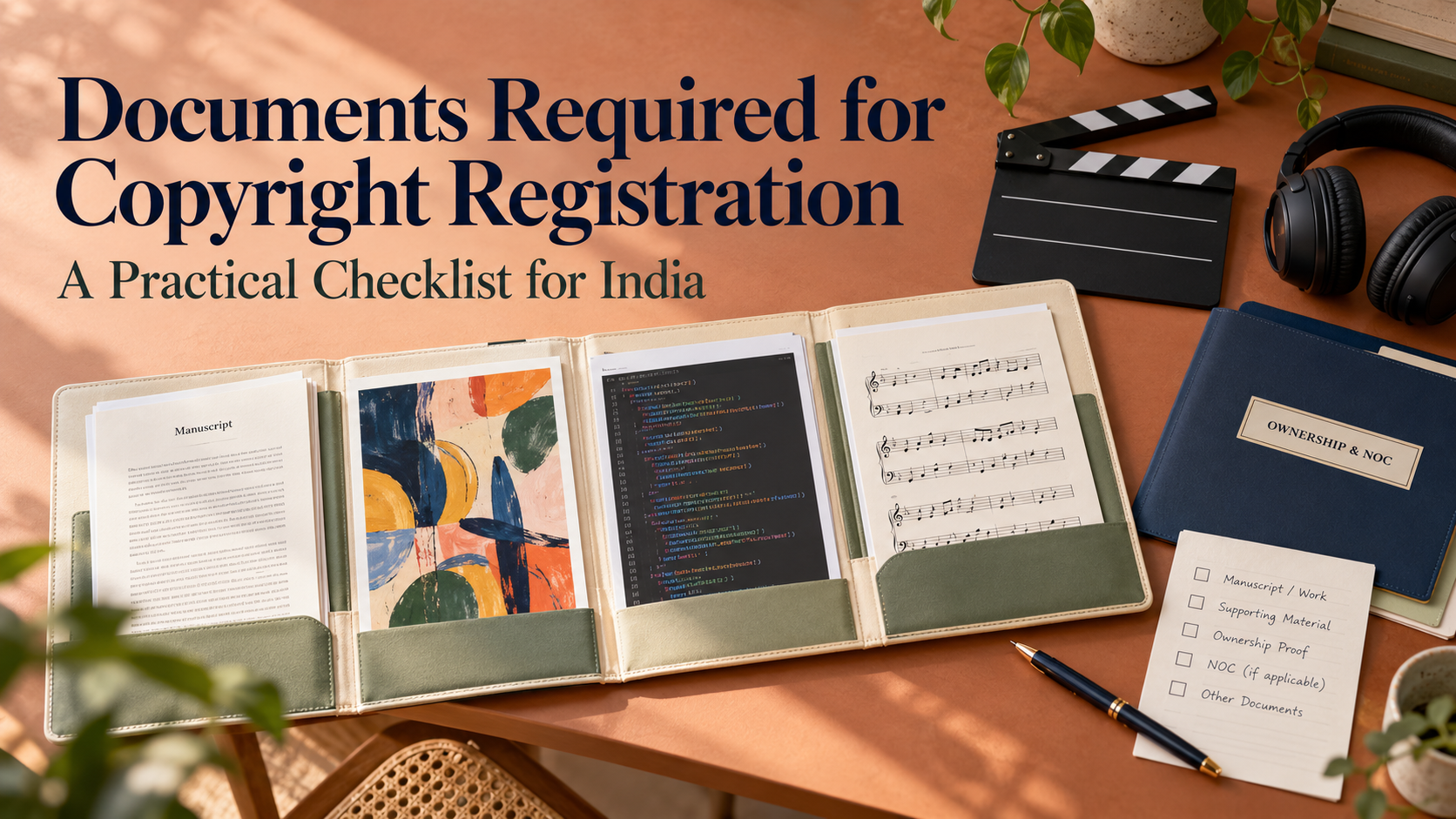
Your starting checklist should include:
- Form XIV and the relevant statements.
- Applicant and author particulars.
- The work being submitted.
- Published or unpublished status.
- Evidence supporting ownership.
- Applicable NOCs or agreements.
- Power of attorney, where relevant.
Not every applicant needs every document. If you are registering your unpublished poem you will have a file that is different, from the file a company uses when applying for software that was developed by an outside team. Use the checklist as a starting point then work through what applies to you.
Core Documents: Start With the Basics
First, choose the exact work and version you intend to submit. This might seem simple. It really matters when multiple versions are floating around. A manuscript could have been revised more or the artwork might be available in different color options.
You’ll need Form XIV, the Statement of Particulars and, where applicable, the Statement of Further Particulars. The application and relevant statements require the applicant’s signature. Appointing a representative does not mean every signature can be delegated.
Check Who Is Applying and Who Created the Work
The documents required for copyright registration should support the details entered in the form.
Check:
- The applicant’s correct name, address and nationality.
- The author’s details.
- Whether the applicant claims as author, owner or assignee.
- The work’s title and language.
- Its publication status.
- Relevant publisher and publication particulars.
In books and art pieces it is vital to name the real creator instead of merely listing the company as the author. For movies and music the rules, about authorship are different. The creator of the film or recording may be listed separately.
What Changes According to the Type of Work?
Your copyright application documents need to represent the work you’re claiming. A promotional screenshot or website link may not be enough.
Check the current filing instructions before preparing uploads or sending physical copies.
Books, Scripts and Artwork
For a manuscript, poem or script, prepare a readable copy with a title that matches the application.
For artwork, check that the submitted image accurately shows the piece. Look at colours, text and composition before approving it.
Additional requirements may involve:
- Publisher details and an NOC where relevant.
- Information about a person whose photograph appears.
- Design-registration or industrial-reproduction details.
- A Trade Marks Registry search certificate for qualifying artistic work used or capable of use in relation to goods or services.
That search certificate needs separate attention. Having a trademark registration is not the same thing.
Software and Computer Programs
Software is registered as a literary work.
Current requirements call for at least the first ten and last ten pages of source code, or the entire source code if it contains fewer than twenty pages, without blocked-out or redacted portions.
Before submission:
- Identify the software version.
- Confirm that the code relates to that version.
- Check readability and completeness.
- Review contributor and ownership arrangements.
- Follow the current upload instructions.
Older checklists may still mention both source and object code. Follow the amended requirement rather than assuming an older document remains accurate.
Music, Sound Recordings and Films
A song may involve lyrics, a musical composition and a particular recording. A film may bring together a script, music, footage and several other contributions.
The documents required for copyright registration should reflect the particular work and rights being claimed.
Prepare the work copy and check the relevant agreements or permissions. The current filing guidance says to upload an MP3, for recordings and submit physical copies for cinematograph works so make sure to review the submission instructions carefully.
Keep contributor information organised too. Registering a recording or film does not remove the need to resolve rights in material used within it.
Ownership Documents: Explain How the Rights Belong to You
Having the final file doesn’t necessarily establish ownership.
Suppose your business hired a freelance illustrator. You approved the design, paid the invoice and received the files. Before applying as owner, check what the agreement says about copyright.
Depending on the arrangement, useful records may include:
- A written assignment.
- Employment terms.
- Commissioning agreements.
- Production or contributor agreements.
- Relevant licences.
- Inheritance or succession documents.
An assignment must meet legal requirements. It should identify the work and address the rights transferred, duration and territorial extent.
Keep invoices, emails and delivery records, but don’t assume they answer every ownership question. If the agreement is unclear, have it reviewed before filing. The claim in the application needs to match the rights you actually hold.
When Is an NOC Needed?
An NOC, or No Objection Certificate, records that the relevant person does not object to the proposed registration.
If you’ve searched for “NOC copyright”, you may have found several templates. Before choosing one, establish whose consent is relevant and what the document needs to say.
Copyright Office guidance calls for an author’s NOC where the author differs from the applicant. Other circumstances can involve a publisher, legal heirs or a person whose photograph appears in the work.
Check that the NOC:
- Identifies the correct work.
- Names the applicant accurately.
- States the relevant consent.
- Explains the signatory’s capacity where needed.
- Is properly signed.
An NOC Is Different From an Assignment
A statement saying “I have no objection to registration” should not automatically be treated as a complete transfer of rights.
An assignment addresses ownership of specified rights. An NOC supports the consent position for the application. Your circumstances may require a review of both.
The documents required for copyright registration should make that distinction clear. If several people contributed, work out their roles and rights before sending documents around for signatures.
Your Final Document Check Before Filing
Give the complete application one final review. It helps to ask someone to compare the form with the attachments, rather than checking each file separately.
Look for:
- Matching titles: Does the form identify the submitted work correctly?
- The intended version: Have you attached the final copy?
- Accurate authorship: Are the relevant creators identified?
- Supported ownership: Do the agreements match the claim?
- Correct publication details: Have dates and publisher information been checked?
- Required consent: Are applicable NOCs included?
- Complete authorisation: Is representative paperwork ready?
- Proper submission: Are formats and copies correct?
Also review the requirement to notify other interested parties. An NOC does not automatically replace a separate procedural notice.
Save the application, attachments, payment evidence and diary number together. If a question arrives later, you’ll want to find exactly what was submitted.
Frequently Asked Questions:
Yes. Publication is not a prerequisite. State the unpublished status accurately and provide the copies required under the current rules and filing instructions.
Generally, copyright arises automatically in qualifying works. Registration does not create that protection, although entries in the register can serve as prima facie evidence.
Potentially, if it holds the relevant rights. Review the ownership agreement and applicable author-NOC requirements rather than relying only on payment.
No. The number identifies the filed application. Examination and any required clarification still need to be completed before registration.
A website can contain several works, including text, code, photographs and videos. Identify the particular work being claimed instead of assuming one application covers everything.
Conclusion
Copyright registration documents get simpler to organise if you first figure out three points: what the work is, who made it and how ownership is proven. Look at the needed NOCs. Then compare the final copyright registration application with its attachments. If you feel stuck copyright registration services in Delhi can help by looking over the file and pointing out any questions that need to be answered before you send it in.
Leave a Reply