The client has approved the campaign strategy, the team has started working, and now everything appeared to be on time. Then the client has requested some designs and after some time the client is asking for another set of changes. At the same time the freelancer who has made the artwork is asking for payment. No one knew who had ownership of the files.
Sound familiar? Situations like these are fairly common in digital agencies. They’re also the reason contracts matter more than most agency owners initially realise. Having someone review those agreements before problems arise can save considerable time and frustration. Many agencies choose to hire a fractional legal consultant rather than maintain a full-time legal team.
A legal retainer for agencies India gives growing businesses access to ongoing legal support for client contracts, freelancer arrangements, and intellectual property matters. The idea is simple: get the important details right before they turn into expensive disagreements.
What Contracts Does a Digital Agency Need?
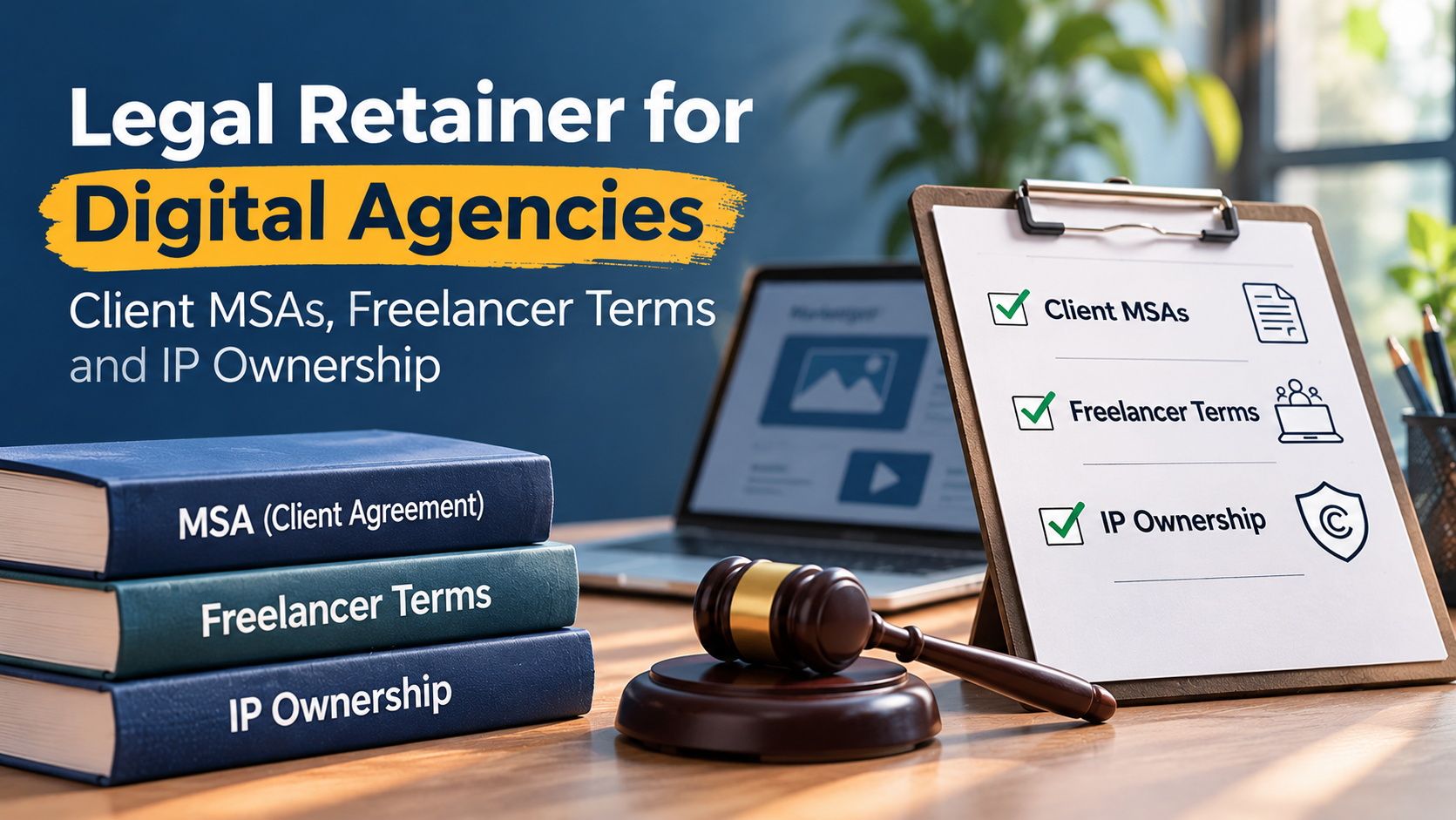
Most digital agencies need five contractual arrangements. Digital agencies normally start with a Master Services Agreement (MSA), Digital agencies then add a Statement of Work (SOW) and also include a freelancer agreement. Digital agencies further sign a confidentiality agreement, and finally secure an intellectual property assignment provision.
Each has its job. The MSA sets the rules of your client relationship while the SOW says exactly what you are providing. Freelancer agreements set out what each person is responsible, for and IP clauses make clear who is allowed to use the project
Here’s what you should have:
- Client MSA: General commercial terms and responsibilities.
- Statement of Work: Deliverables, deadlines, fees, and revisions.
- Freelancer Agreement: Work expectations, payment, and ownership.
- Confidentiality Agreement: Protection for sensitive information.
- IP Assignment: Rights to creative work and other deliverables.
You may not need five separate documents for every project. Some provisions can be combined, depending on the engagement.
Why a Legal Retainer for Agencies India Makes Sense
When you run an agency contracts feel like another administrative chore. You send a proposal the client agrees via email and work starts. That arrangement feels convenient until something goes wrong with contracts.
Maybe a client refuses to pay because they didn’t like one part of the work. A freelancer quits in the middle of a project and takes the source files with them.
These problems don’t always need a legal fight. A clear written agreement could have made things much easier to handle.
The Problems Agencies Commonly Run Into
Most contractual problems start with expectations that were never properly discussed. For example:
- A client assumes unlimited revisions are included.
- An agency expects payment before handing over final files.
- A freelancer wants to reuse work created for a client.
- A project gets cancelled, but completed work remains unpaid.
- Both parties disagree about who owns the campaign assets.
A legal adviser can spot these gaps while the agreement is being drafted and a legal adviser can fix them before the relationship turns tough.
Client MSA: Getting the Basics Right
A Master Services Agreement is essentially the rulebook for your relationship with a client. It covers the general terms that apply whenever your agency provides services.
Let’s say you’ve been managing a client’s Instagram account for six months. They now want you to handle Google Ads as well. Instead of negotiating every legal term again, you can use the existing MSA and prepare a new Statement of Work for the additional services.
What an Agency Client Agreement India Should Cover
A useful agreement should explain:
- What services your agency is responsible for.
- When and how the client must pay.
- How approvals and feedback will work.
- What happens when deadlines are missed.
- Who owns the completed work.
- When either party can end the engagement.
- How disagreements will be handled.
The language doesn’t need to be unnecessarily complicated. What matters is that both sides understand their responsibilities.
Don’t Leave Payment Terms Open to Interpretation
Imagine finishing a website and then being told the client will pay when they are completely satisfied. What does completely satisfied really mean?
Your contract should tie payments to milestones, deadlines or clear deliverables. It should also outline what happens when invoices are not paid and when work might need to stop.
Scope Changes: When a Small Request Becomes Extra Work
Every agency has heard some version of, “It’s just one small change.”
Sometimes it really is small. Other times, that request becomes three additional landing pages, another video, and a complete redesign of the original campaign.
The problem isn’t that clients request changes. It’s that nobody has agreed on where the original scope ends.
Make Extra Work Easy to Approve
You don’t need a complicated procedure. A short written change request can establish:
- What the client wants added or changed.
- How much additional work is involved.
- Whether the price will increase.
- How the delivery date will change.
- Who must approve the revised scope.
This keeps the conversation professional without making the client feel that every minor request is a legal issue.
Freelancer Terms: Don’t Rely on WhatsApp Agreements
Freelancers make it possible for agencies to handle different kinds of projects without hiring a permanent specialist for every service.
You might bring in a designer for a branding project, a developer for a website, or a video editor for a campaign. But a few messages discussing deadlines and payment don’t necessarily address everything that matters.
What Should a Freelancer Agreement Include?
At a minimum, clarify:
- The work being commissioned.
- Delivery dates and file formats.
- Payment milestones.
- Confidentiality obligations.
- Ownership or licensing of deliverables.
- Use of third-party materials.
- What happens if the project ends early.
It’s particularly important to agree on whether the freelancer can reuse the work in their portfolio or for other clients.
IP Ownership: Who Actually Owns the Creative Work?
Here’s something agencies sometimes discover too late: paying for creative work doesn’t automatically transfer every copyright associated with it.
If your agency hires a freelance illustrator to create packaging artwork the client pays your agency. Then your agency pays the illustrator. Does that mean the client automatically has all the rights, to the illustration?
Not necessarily. Ownership depends on the law, the nature of the work, and the agreements involved.
Why Freelancer IP Assignment Matters
A freelancer IP assignment clause sets out which rights the creator transfers and under what conditions.
Under India’s Copyright Act, copyright assignments generally need to be in writing and signed by the assignor or an authorised agent. They should also address the rights assigned, duration, territory, and applicable consideration.
A clear agreement helps avoid a situation where the agency promises a client rights it hasn’t actually obtained.
Protecting the Work Before Client Handover
Before delivering a logo, website or campaign check whether the necessary rights and licences are in place.
You should also distinguish creative work, from stock images, fonts, templates and other third‑party assets. Those materials may have licensing conditions.
For eligible original works, copyright registration in Delhi can provide useful documentary evidence of a copyright claim, although registration isn’t mandatory for copyright protection to arise.
What Does a Legal Retainer Actually Help With?
A legal retainer for agencies India isn’t necessarily about having a lawyer involved in every client conversation. It’s about having legal support available when a contract needs attention or a business decision raises legal concerns.
Depending on the agreed services, that support might include:
- Reviewing a new client’s MSA.
- Preparing a freelancer contract.
- Checking an IP ownership clause.
- Advising on unpaid invoices.
- Reviewing termination provisions.
- Updating agreements as services expand.
For agencies signing contracts regularly, this can be more convenient than arranging separate legal assistance each time.
Choosing Legal Support That Fits Your Agency
A social media agency with five people does not always require the legal help as a bigger company that creates software and runs campaigns all, around the world.
Start by looking at the problems you encounter most often. Are clients regularly requesting additional work? Are freelancer arrangements becoming difficult to manage? Do your contracts clearly explain ownership?
Your answers can help determine the type and frequency of legal assistance you need.
Frequently Asked Questions:
An MSA isn’t required for every client interaction. It helps a lot when you work with the same clients over time. It sets rules and keeps things consistent. That way you don’t have to go and argue over basic details each time a new project starts.
Depending on the circumstances freelancers may keep the copyright in the work they create. A written agreement or license can clearly explain which rights the agency gets.
Set revision limits in the SOW and use written change requests for additional work. That way, the client knows when extra charges or revised deadlines apply.
No. Copyright generally arises automatically in eligible original works. Registration may provide useful evidence if ownership or infringement becomes disputed.
It can be helpful especially if you often sign agreements, with clients or work with people who work on their own. The choice depends on what you need how contracts you have and how much money you have to spend.
Conclusion
Running an agency comes with a lot of challenges. A digital agency doesn’t want to waste time arguing over invoices dealing with never-ending changes or getting into arguments, about who owns the work. Digital agency owners can avoid many of these problems by using clear client MSAs, scope‑change terms, well‑written freelancer agreements and written IP assignments. A legal retainer for agencies, in India gives digital agency owners a way to answer questions right away instead of waiting for a problem to happen. The real value of a retainer is not just having contracts. It is knowing what the digital agency has agreed to what clients can expect and how the digital agency is protected as it grows.
Leave a Reply