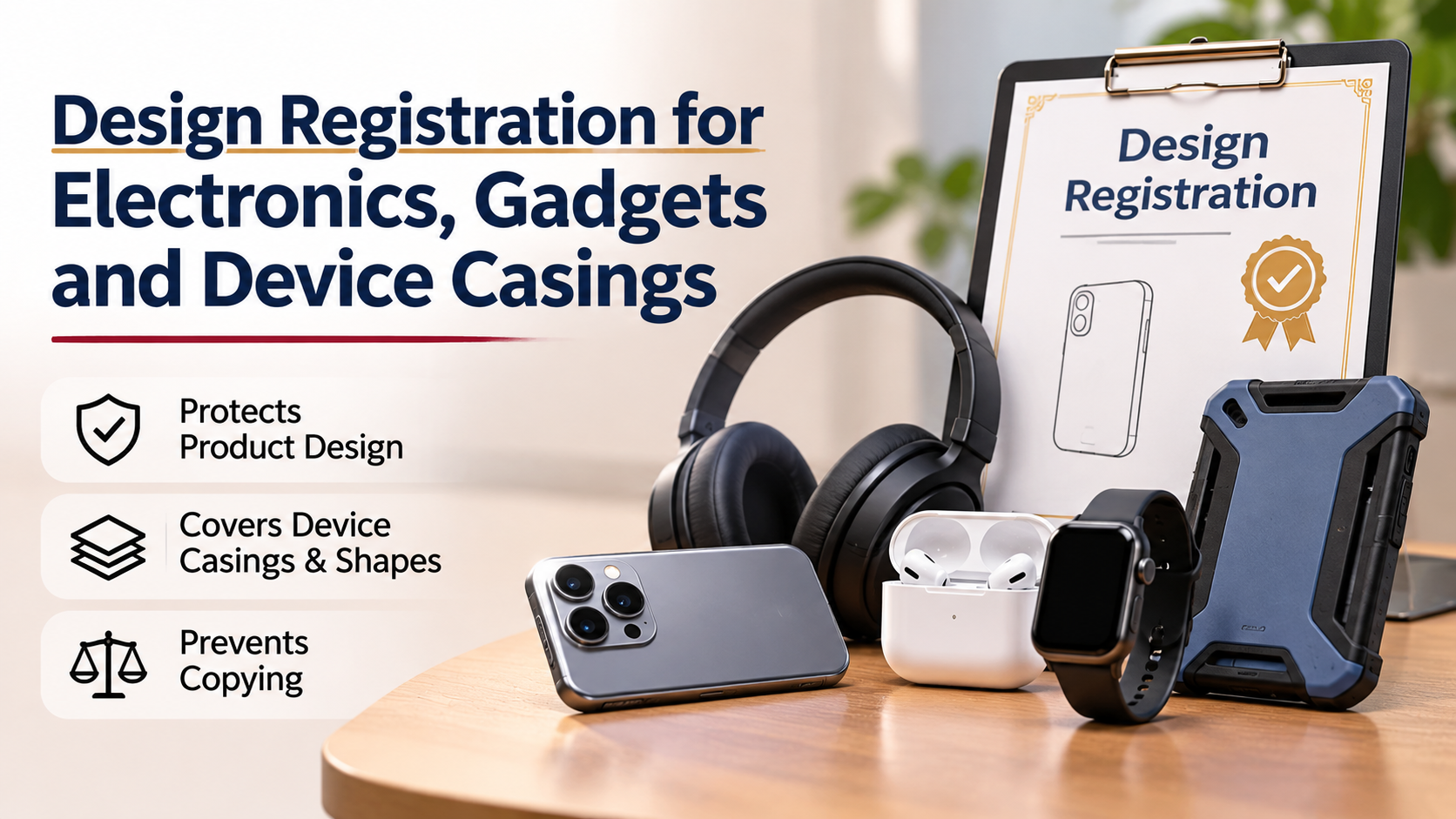
Imagine you’ve spent months developing a new wireless speaker. It works well, sounds great, and has a unique curved body that makes it stand out from other speakers. You finally launch it, and customers love the design. A few months later, another company introduces a speaker with an almost identical appearance. Frustrating, right? You worked hard to create something different, but now another business is selling a product that looks remarkably similar.
This is where design registration for electronics becomes important. It helps businesses protect the visual appearance of their products, including certain shapes, patterns, and decorative features. If you’re developing electronic products, you can register your product design to seek legal protection for eligible visual features before competitors copy them.
Can a Gadget’s Appearance Be Registered as a Design?
Yes. A gadget can be registered under the Indian Design law, subject to meeting the criteria laid out under the Designs Act, 2000. This law provides protection to the aesthetic features of a product.
For example, a company may wish to protect the unique design of the casing of a smartwatch, the look of a wireless earbud casing or the attractive design of a portable speaker.
However, the design must generally be:
- New or original.
- Applied to an article through an industrial process.
- Visually identifiable in the finished product.
- Different from previously published designs.
- Not purely functional.
Registration is not automatic. The design must satisfy the applicable legal requirements.
Understanding Design Registration for Electronics
Electronic products are no longer judged only by their performance. Customers also notice how they look, feel, and fit into everyday life. Think about smartphones. Many devices offer similar basic features, but their shapes, camera arrangements, and overall appearance can make them instantly recognisable.
Design registration for electronics allows businesses to seek protection for eligible aesthetic features that give their products a distinctive appearance.
This can be useful for manufacturers, startups, product designers, and companies developing consumer electronics. Products that may contain registrable designs include:
- Smartwatch bodies.
- Wireless earbud cases.
- Bluetooth speakers.
- Power bank casings.
- Gaming controllers.
- Electronic accessories.
- Smart home devices.
The important question is whether the claimed design concerns the product’s appearance rather than its technical function.
Appearance vs Function: What Can Be Protected?
This is one of the most important distinctions in design law. A product may look unique and work differently from other devices, but design registration does not protect every feature.
Visual Features Eligible for Protection
Under the Designs Act, 2000, designs such as shape, configuration, pattern, ornamentation, or composition of lines or colour or combination thereof can be protected. An example would be a unique wavy exterior on a portable speaker.
If that shape is new, original, and satisfies the legal requirements, it may qualify for design registration. Other examples include:
- A distinctive smartwatch frame.
- Decorative patterns on a device casing.
- The ornamental shape of a charging dock.
- A unique external configuration of a gadget.
The focus is on how the finished article appears to the eye.
Functional Features That May Not Qualify
Suppose a company develops a new cooling mechanism that prevents a laptop from overheating. That technical invention cannot be protected merely through design registration.
A design could also be excluded if it was an entirely functional feature of a component. This is as the law only protects the look of a product and not functional features.
Businesses should identify any aesthetic features in their product.
Why Gadget Design Protection Matters
The appearance of a gadget can influence a customer’s buying decision. A well-designed product may be easier to recognise, more attractive on store shelves, and more memorable than competing products.
But developing that appearance takes time. Businesses invest in sketches, prototypes, materials, and product testing before arriving at the final design.
Gadget design protection can help protect eligible visual features against unauthorised imitation. Registration may help businesses:
- Establish rights in a registered design.
- Address unauthorised copying of protected features.
- Support product licensing arrangements.
- Build a stronger intellectual property portfolio.
- Protect investment in product appearance.
It does not prevent every competing product from entering the market. Protection is limited to the registered design and the rights provided by law.
Design Registration vs Patent Protection
Businesses often mix up design registration with patent protection because both can apply to the electronic product. They protect different things. Design registration is about the look, the visual appearance of a product. Patents on the hand protect the technical side—how it works, the invention itself. So even if a device looks different it doesn’t mean it’s protected by a patent. Likewise, a patent doesn’t cover how the product looks. They serve purposes, one is about looks, the other is about function.
For example, imagine a company developing a new fitness tracker. The tracker may include a novel sensor technology and a distinctive external casing. The sensor technology may be considered for patent protection if it meets the patentability requirements. The casing’s eligible visual features may be considered for design registration.
When Design and Patent Protection May Overlap
A single product can contain different types of intellectual property. A smart home device, for example, might have:
- A technical invention relating to its operation.
- A distinctive external shape.
- A brand name identifying its manufacturer.
- Software protected under applicable intellectual property laws.
These elements may require different forms of protection.
Businesses developing new technology can explore patent registration for qualifying inventions while separately considering design protection for the product’s appearance.
Protecting Device Casing Designs
A device casing does more than hold electronic components together. Its appearance can become an important part of the product’s identity.
Consider two power banks with similar charging capabilities. One has a conventional rectangular body, while the other features a distinctive curved casing with decorative surface details.
The second product may have visual features worth examining for design protection. A device casing design may include:
- The external shape of the casing.
- Distinctive surface ornamentation.
- Decorative contours.
- A particular visual configuration.
- Unique patterns applied to the exterior.
However, not every casing will qualify. A common shape or one dictated solely by technical requirements may face objections.
Importance of Design Views and Drawings
When applying for design registration, clear representations are essential. The Design Office needs to understand exactly what appearance the applicant wants to protect.
For a three-dimensional electronic product, this may involve drawings or photographs showing different angles. Depending on the design, relevant views may include:
- Front view.
- Rear view.
- Top view.
- Bottom view.
- Left-side view.
- Right-side view.
- Perspective view.
The representations should be consistent and clearly show the claimed features.
Common Mistakes in Design Representations
If you had to draw a smartwatch that appears round on the front but has an ambiguous shape when viewed from the side. This creates ambiguity in what the designer is claiming their product looks like.
Common problems include:
- Blurry photographs.
- Missing relevant views.
- Inconsistent shapes across drawings.
- Unnecessary background objects.
- Unclear visual features.
Preparing accurate representations can help reduce avoidable examination objections.
How to Register an Electronic Product Design
The registration process begins with identifying the appearance you want to protect. Before filing, businesses should check whether similar designs have already been published or registered.
The general process involves:
- Identifying the eligible visual features.
- Conducting a design search.
- Selecting the appropriate article classification.
- Preparing drawings or photographs.
- Filing the application in the prescribed form.
- Responding to examination objections, if any.
- Obtaining registration if the application is accepted.
The application should accurately describe the design and the article to which it is applied.
Documents Required for Design Registration
The exact requirements depend on the application and applicant. Businesses commonly need to prepare:
- Applicant details.
- The name of the article.
- The appropriate design classification.
- Clear representations of the design.
- A statement of novelty where applicable.
- Authorisation documents if an agent is appointed.
- Priority documents if priority is claimed.
Applicants should also verify the applicable filing fee and current requirements before submission.
Common Reasons for Design Registration Objections
Not every design application receives approval. The Design Office may raise objections when the claimed design does not satisfy the legal requirements. Possible concerns include:
- The design is not new or original.
- A similar design has already been published.
- The claimed features are purely functional.
- The representations are unclear.
- The article classification is incorrect.
- The application contains inconsistent information.
For example, changing the colour of an ordinary gadget casing may not, by itself, make the overall design registrable. The assessment depends on the claimed features and the applicable legal standards.
How Long Does Design Protection Last?
In India, a registered design generally receives protection for the period of 10 years from the registration date depending on the applicable statutory provisions. The protection can be extended once for another five years by following the required steps.
The longest period of protection for a registered design is generally 15 years. After the protection period expires a registered design no longer benefits, from the rights provided by the registration. Businesses should keep records of registration dates and extension deadlines.
When Should Electronics Businesses Apply for Design Registration?
Ideally businesses should think about design protection before they share their product with the public. Picture this – you launch a gadget at a trade show and then later you decide to apply for registration. That kind of timing can cause problems.
Public disclosure might affect the novelty of the design depending on the situation and the rules in place. So before launching businesses should take a look, at the legal requirements. They should make sure their design is protected or they could lose the right to register it. Planning ahead is the way to avoid trouble. Before launching businesses should:
- Finalise the design.
- Review existing designs.
- Identify the features worth protecting.
- Prepare accurate representations.
- Consider filing before public disclosure.
Early planning can help avoid unnecessary risks to registrability.
Frequently Asked Questions
Yes. A gadget’s shape may qualify for registration if it is new or original, visually identifiable, and meets the requirements of the Designs Act, 2000.
A mobile phone casing may qualify if its claimed appearance satisfies the legal requirements. Common or purely functional features may not be eligible.
No. Design registration protects eligible visual features. Technical inventions may require patent protection.
Yes. Startups, established businesses, and eligible individuals can apply for design registration, subject to the applicable requirements.
Registration is not generally mandatory for launching a product. However, filing before public disclosure may help preserve the novelty required for protection.
Possibly. Whether a design qualifies depends on its overall visual features, earlier designs, and the applicable legal tests for novelty and originality.
Conclusion
In terms of electronic products, there could be many benefits to registering your design. This can include everything from the casing of smartwatches to speaker boxes. Design registration for electronics can allow businesses to register a distinctive design that is eligible to be protected. Understanding the differences between design and function, having clear design drawings and registering at the right point can help manufacturers make the best decision. Those who wish to have professional support could look into design registration services in Delhi to learn about what is required for you to register your designs.
Leave a Reply