Suppose you hire a designer to design a logo for your business. You pay for the design and receive the final files. However, after a few months you discover the designer still claims ownership to the artwork. Often situations such as this occur due to a lack of understanding regarding copyright assignment vs licence.
Both options allow someone to use your copyrighted material. Understanding the differences can help you avoid issues if you are a business owner, content creator, publisher or freelancer. However, businesses can also consider copyright registration in Delhi.
What Is the Difference Between Copyright Assignment and Licence?
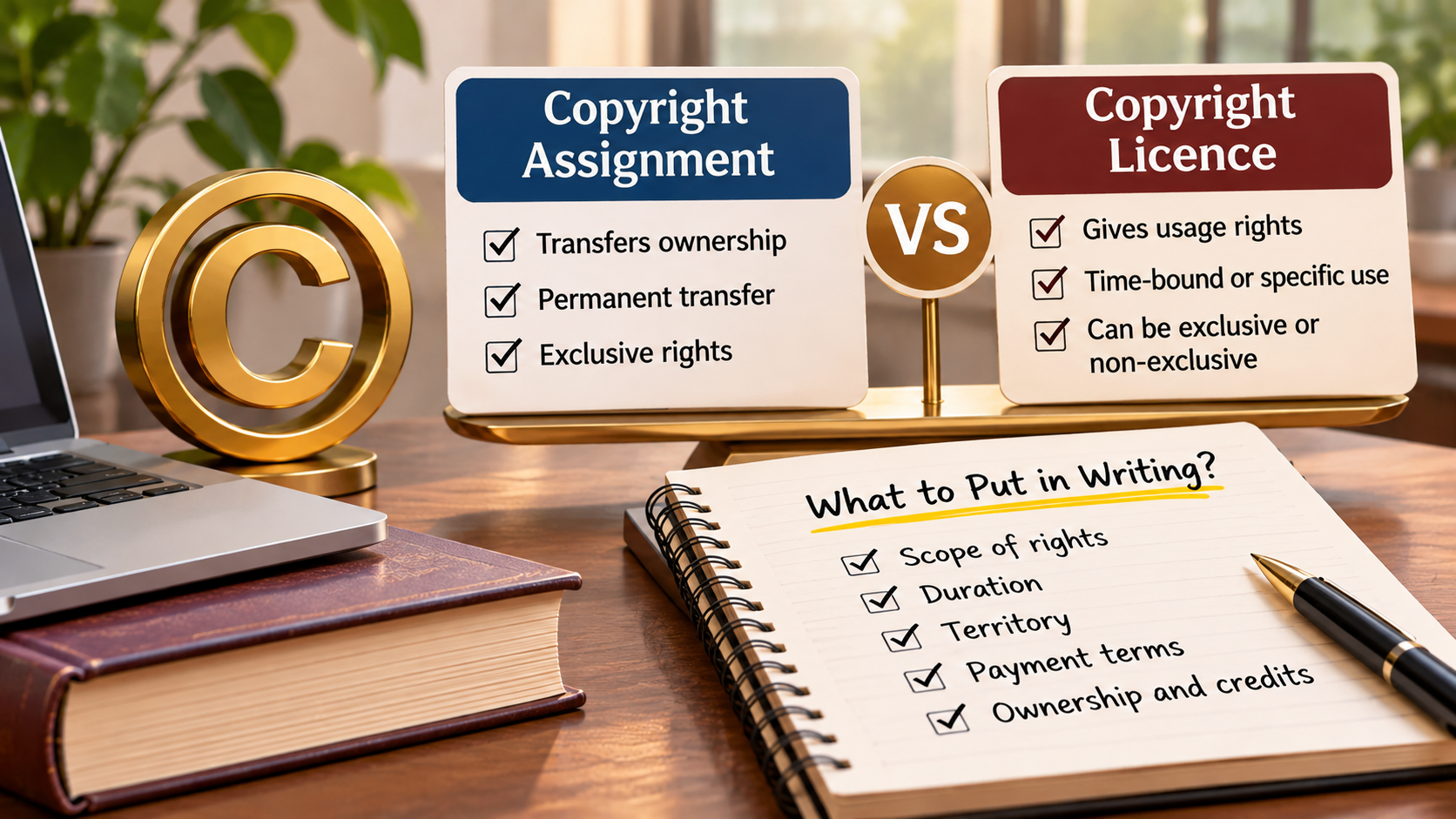
The key difference between the two methods is the transfer of ownership. With copyright assignment specific rights will be transferred to another party. Whereas with a licence, they can use your rights.
For example, a photographer may wish to assign the copyright of their image to a company or simply licence it for advertising. It depends on whether you want to transfer ownership or if you want permission to use them.
Understanding Copyright Assignment and Licensing
Copyright protects original works such as books, photographs, music, software, illustrations and other eligible creative material.
Sometimes the copyright owners may wish to assign their rights or allow someone else to use them commercially. Both options are recognised within Indian copyright law.
What Is Copyright Assignment?
Copyright assignment means transferring the ownership of specific economic rights.
Under section 18 of the Copyright Act 1957, a copyright owner can assign their copyright fully or partially.
For example, a writer may wish to assign the publishing rights of their book to a publishing company. Copyright assignment can include:
- Transfer of all or some rights
- Transfer of the whole copyright or for a specific time period
- Transfer of rights for specific territories
- Transfer of rights for specific commercial use
What Is Copyright Licensing?
Copyright licensing means allowing someone else to use your copyrighted material within specific terms. The copyright owner will retain ownership.
For example, a photographer may licence an image to a company for use within their marketing. Your licence may include restrictions on:
- Where they can use the image
- How long they can use it for
- If they can make changes
- If they can use it within other businesses.
Licensing is often a good option if creators want to keep ownership but earn money from their work.
Copyright Assignment vs Licence – Key Differences
Understanding the differences between copyright assignment vs licence can help businesses choose the right option for their commercial needs.
Both options can include payment, restrictions and contractual obligations. However, there are differences in the legal implications.
Ownership
With copyright assignment, the assignee will own the rights. With a licence, the original owner will retain ownership and allow the licensee to use the rights. For example, if you are commissioning software you may want to own the rights.
Exclusive Or Non-Exclusive
Licences can be exclusive or non-exclusive. Exclusive licences mean the licensee can have specific rights and no-one else including the copyright owner can have those rights.
Non-exclusive licences mean the copyright owner can give similar permissions to others. With copyright assignment, ownership will be transferred.
Which Rights Are Being Assigned/Licensed?
There are many economic rights attached to copyright. Within your agreement it is important to clearly state which rights are being transferred. Depending on the work, this can include:
- Reproduce
- Distribute / Issue copies
- Communicate to the public
- Adapt
- Translate
- Other rights under the Copyright Act.
For example, a publisher may have rights to reproduce and distribute a book but not all the rights.
Economic Rights & Moral Rights
Economic rights give copyright owners the ability to control specific uses of their work commercially. Moral rights, recognise under section 57 of the Copyright Act, protect certain author’s rights including claiming authorship and preventing prejudicial treatment of their work.
These are separate to economic copyright ownership. Therefore, businesses shouldn’t assume that buying copyright removes all legal rights the author may have.
Duration of Copyright Assignment and Licence
Duration is another important consideration in copyright assignment vs licence agreements.
Copyright assignment may last for a specific length of time whereas licensing may have a shorter time. For example, you may licence background music for your advertising campaign for 1 year.
Length & Territory
Under section 19 of the Copyright Act, copyright assignment should state how long it will last for and which territory. If the length isn’t mentioned then it will generally be assumed to be 5 years. If the territory isn’t mentioned it will generally be assumed to be within India.
Section 19 also includes information about how the rights can be used and when the assignment can lapse. Care should be taken when considering the terms of licensing and what the statutory rules are.
Written Requirements for Copyright Assignment in India
When dealing with an assignment of copyright India, written documentation is particularly important.
Under section 19, copyright assignment must be in writing and signed by the assignor or their authorised agent.
Under section 30, licences given by copyright owners must also be in writing and signed by the owner or their authorised agent. Verbal agreements may not be enough.
Key Clauses to Include in Your Assignment Agreement
Your copyright assignment should clearly state what rights are being transferred. Key clauses to include are:
- Identification of the copyrighted work.
- Details of the assignor and assignee.
- Specific rights being assigned.
- Duration of the assignment.
- Territorial extent.
- Royalty or consideration arrangements.
- Applicable warranties and obligations.
- Dispute resolution provisions.
Businesses can use professional agreement drafting and review services to identify unclear terms and reduce contractual risks.
Professional services can be used to help draft and review your agreement to ensure any unclear terms are identified and reduce risk.
Key Clauses to Include in Your Copyright Licence
Your licensing agreement should clearly state what the licensee can do. Common clauses include:
- What can be used
- Exclusive or non-exclusive
- How long for and where
- Licence fees/royalties
- Limitations on changes
- Sub-licensing
- Termination
- Un-authorised use
For example, a designer may allow the company to use an illustration on their packaging but not on unrelated products.
Common Mistakes in Copyright Agreements
Sometimes businesses and creators enter into agreements without closely considering the rights involved. This can cause issues even if both parties had good intentions. Common mistakes include:
- Assuming payment means copyright has been assigned
- Unclear description of what rights are being transferred
- No mention of how long or where
- Confusing exclusive licences with assignment
- Not considering royalties
- Not considering moral rights
- Using generic contracts and not considering ownership.
For example, just because you have paid a freelancer for their design doesn’t mean you have assigned all copyright rights. It will depend on the law and the agreement.
Choosing Between Assignment and Licensing
The choice between copyright assignment vs licence depends on how much control each party needs. Copyright assignment may be a good option if you need specific rights for long term commercial purposes. Whereas licensing may be a better option if you want to keep ownership. Consider:
- Do you need to transfer ownership?
- How will you be using the work commercially?
- Do you need exclusive rights?
- How long will you be using it for?
- Will you have the opportunity to licence it in the future?
- Are there any payment/royalty requirements?
Ensure your agreement is well drafted and reflects the real relationship.
FAQs:
Not necessarily. Copyright can be assigned for a set period of time or for the relevant copyright period.
No. Under section 19, copyright assignment must be in writing and signed by the assignor or their authorised agent.
No. Licensing will allow specific use of your copyrighted material. The copyright owner will generally retain ownership.
Yes. Copyright licences can be exclusive or non-exclusive. An exclusive licence grants specified rights to one licensee, while a non-exclusive licence allows the owner to grant similar rights to others.
Yes. Copyright owners can assign specific rights, such as reproduction, distribution, or adaptation, while retaining ownership of other rights.
No. Copyright registration is generally not mandatory. However, it can be useful to have evidence of your work.
Conclusion
Understanding the difference between copyright assignment and licensing can be important for businesses, creators and professionals working with IP. Copyright assignment transfers specific ownership rights whereas licensing allows controlled use. Having clear agreements around what rights are being used, how long for, where payment and obligations can help avoid issues. Consider using online copyright registration in Delhi.
Leave a Reply