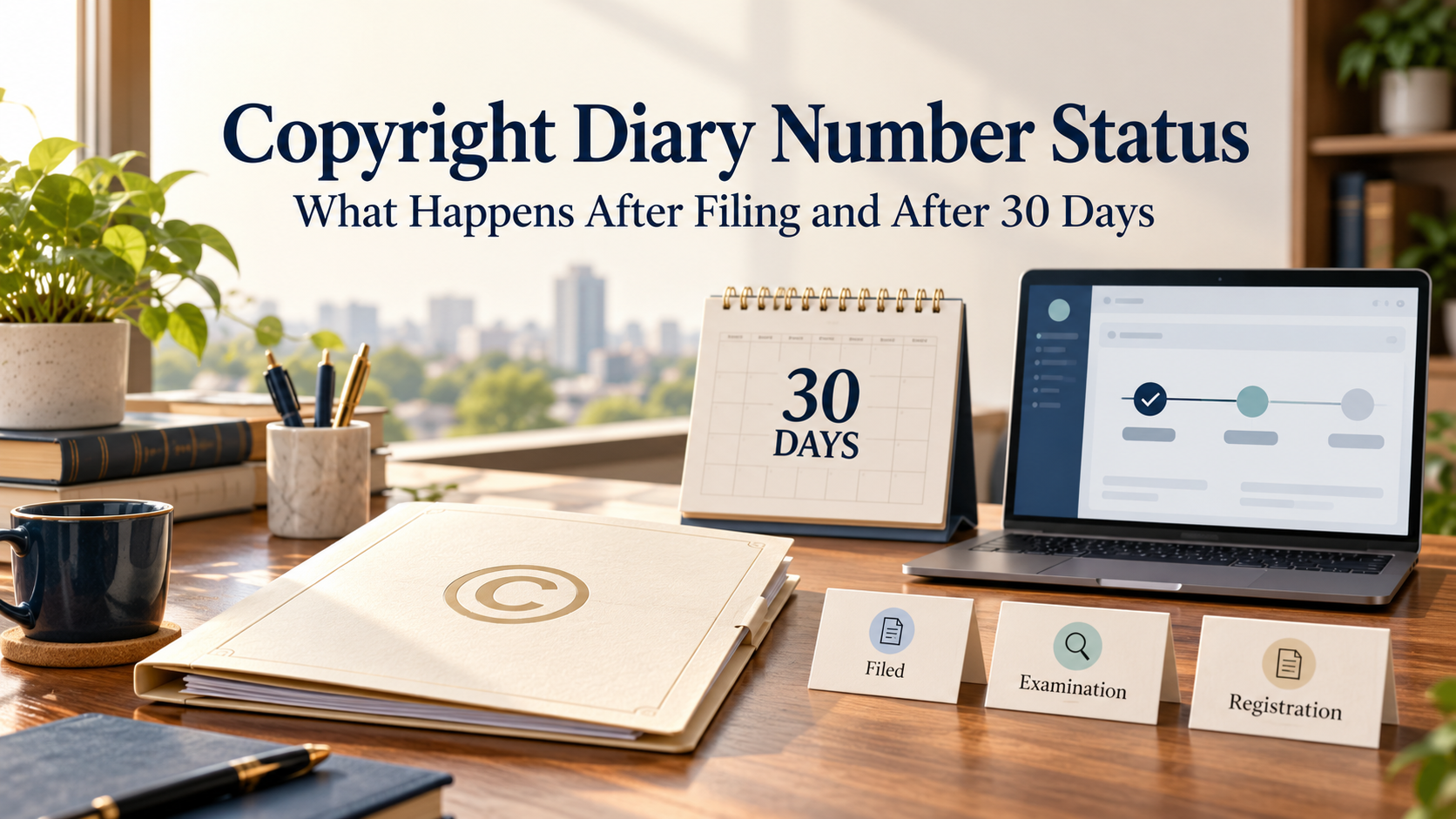
You’ve filled in the application, paid the fee and finally received your diary number. That feels like progress—and it is. But then a question comes up: “Am I done, or is there something else I need to do?” If you’re getting copyright filing support in Delhi make sure you also know who will track the application and respond to any official communication. Your copyright diary number status gives you a way to follow what happens next.
The tricky part? A brief portal message doesn’t always explain much. “Waiting” can feel vague, and “Scrutiny” might sound more worrying than it needs to. Here’s how to understand the process without getting lost in the terminology.
What Happens After I Get a Copyright Diary Number?
After you get a number your application has to wait for 30 days. During that time people can object. If no one objects the application moves forward for checking. The Copyright Office might ask for changes or extra papers before it is registered. Getting a number does not mean your application has been approved.
Think of it as getting an acknowledgement that your application has entered the system. You now have a reference to follow, but there are still steps ahead.
For now, focus on a few practical things:
- Save your acknowledgement and payment receipt.
- Keep the exact application and work you submitted.
- Check whether any submission requirements remain incomplete.
- Watch for official correspondence.
- Agree on who will handle questions if you filed through a representative.
You don’t need to check every hour. You do need to make sure an important request doesn’t go unnoticed.
Diary Number: What It Means and What to Save
Your diary number identifies your application. You’ll use it when checking progress or asking the Copyright Office about your filing.
Copy it directly from the acknowledgement rather than typing it from memory. A missing slash, letter or year detail can make a search unnecessarily frustrating.
If the portal doesn’t return the result you expected, check the reference first. Don’t immediately assume something has gone wrong.
Is a Diary Number the Same as Registration?
No. They relate to different stages:
- Diary number: The reference for your submitted application.
- Registration number: The reference associated with completed registration.
This matters when you speak to clients, publishers, distributors or business partners. If your application is pending, describe it that way.
For example, “We have filed the copyright application” communicates your position more accurately than “Our copyright is registered.”
Keep Your Filing Records Together
Give your application its own folder. Include:
- The submitted application.
- The acknowledgement and fee receipt.
- A copy of the work.
- Supporting ownership documents.
- Declarations and authorisations.
- Official letters and your replies.
- Proof that responses were submitted.
It sounds basic, but this habit saves time. If a question arrives months later, you shouldn’t have to search five inboxes to work out what was filed.
The 30-Day Window: Why You Have to Wait
Once you’ve filed, waiting can feel like the least useful part of the process. You’ve done your bit, so why doesn’t the Office move straight to registration?
The waiting period gives interested parties an opportunity to object to your claim. Someone might, for instance, say they own the work or have an interest that the application doesn’t reflect.
The Registrar must also be satisfied that the application particulars are correct. No objection doesn’t automatically mean every detail has been accepted.
Use this period to check your own records. Can you explain who created the work, who owns it and how those details match the application?
You don’t need to submit extra material without a reason. Just have the relevant documents ready.
What Happens After Day 30?
This is where many applicants get confused. They mark the date check the portal on day 31 and expect a certificate.
The 30-day period is not a guaranteed registration date. It is a procedural waiting window. The examination must still be reviewed. Any necessary follow-up steps also need to be completed.
When checking your copyright diary number status after that period:
- Look for new correspondence.
- Confirm that required work and documents were submitted.
- Check whether your representative received anything.
- Avoid treating an unchanged message as a rejection.
Also, resist the urge to file again simply because the application hasn’t moved as quickly as you expected.
Examination: What Happens Behind the Scenes?
During examination, the Copyright Office reviews the application and supporting material. If something is missing, inconsistent or unclear, it may ask you to address it.
Questions can concern things such as:
- A title that differs between the application and the work.
- Inconsistent author or applicant details.
- Missing signatures or documents.
- Unclear publication information.
- The basis of an ownership claim.
Imagine your company applies for artwork created by a freelancer. The company is named as the owner, but the records don’t explain how it acquired the rights. That leaves a question the examiner may need answered.
The helpful response is a clear explanation supported by relevant documents. Repeating “the artwork belongs to us” doesn’t fill the gap.
How to Handle a Discrepancy Letter
Opening a discrepancy letter can feel discouraging. But the letter itself isn’t a final rejection. It identifies issues you need to address.
The official FAQ says applicants are ordinarily given 45 days to remove discrepancies. Check the actual communication carefully, though, and follow the deadline and instructions applicable to your application.
Work through it in a simple order:
- Read the whole letter. Don’t stop at the first issue.
- Compare it with your filing. Check exactly what you submitted.
- Answer each point separately. Match your numbering to the letter.
- Attach the right documents. Explain what each attachment supports.
- Save the complete response. Keep proof of submission too.
Keep your reply direct. If the Office asks about ownership, answer that question rather than adding a long introduction about your business.
If you discover that an earlier statement may be incorrect, get advice on how to address it properly.
Hearing: What If Your Application Needs Further Discussion?
A hearing may arise when an objection or unresolved issue needs further consideration. The official procedure provides for inquiries, and the FAQ explains that parties may be given an opportunity to be heard where an objection is filed.
Receiving a hearing notice doesn’t tell you the outcome. It does tell you to prepare.
Start with the notice itself:
- What issue needs to be addressed?
- When is the hearing?
- How should you participate?
- Are documents or written submissions requested?
- What authorisation is needed for a representative?
Then put together a short timeline of the relevant events. Arrange your evidence around the questions raised.
A focused explanation is easier to follow than a large bundle of loosely related documents.
Tracking Your Copyright Diary Number Status
Use the official Copyright Office or IP India application-status facility to follow your application. Enter your diary number carefully, then read the displayed update alongside any letters, notices or emails.
A manageable tracking routine could include:
- Checking periodically.
- Recording the date and status.
- Saving important changes.
- Reviewing the email address used for filing.
- Following up with your representative.
- Adding response deadlines to your calendar.
If someone else handles the filing, ask for copies of communications and replies. You should be able to understand where your application stands without reconstructing the story later.
What Common Status Messages Mean
The official tracking page explains several messages you may see:
- Waiting: The application is in the mandatory waiting period.
- Work Awaited: The work has not been received.
- Documents not received, formality check failed: Required documents or works have not been received.
- Scrutiny or Re-Scrutiny: The application is being processed.
- Pending for Hearing or Hearing: The application is at a hearing stage.
- Sub-Judice: A decision from the competent court is pending.
- Registered: The registration record has been generated.
- Abandoned: This may relate to an unanswered discrepancy letter or non-receipt of the work.
Treat these messages as signposts. For the full explanation, read the communication connected with your application.
What to Do When Nothing Seems to Change
An unchanged copyright registration status doesn’t explain why the application is taking time. Start by checking whether anything is outstanding on your side.
If you need clarification, prepare a short enquiry containing:
- Your complete diary number.
- The applicant’s name and work’s title.
- The filing date.
- The current status.
- Details of any response already submitted.
Use the contact channel. A clear enquiry with the reference is more helpful, than sending the same large attachment bundle over and over again.
Frequently Asked Questions
No. It acknowledges the filing and gives you a reference for tracking. The application still needs to complete the relevant processing stages.
Not necessarily. Examination, document requests or proceedings may follow the waiting period.
Check the filing date and official communications first. If you’re unsure whether action is required, contact the Office through an official channel.
Don’t assume you need a fresh application. First assess the issues raised and how to respond to the existing filing.
Find out why by reviewing the relevant correspondence. The next step depends on the application record and any directions issued.
Conclusion
Understanding your copyright diary number status makes the process easier to manage. Keep your records together, remember that 30 days doesn’t guarantee registration, and respond carefully when information is requested. You don’t need to spend your day refreshing the portal. A simple tracking routine—and clear responsibility for the next action—will serve you much better.
Leave a Reply