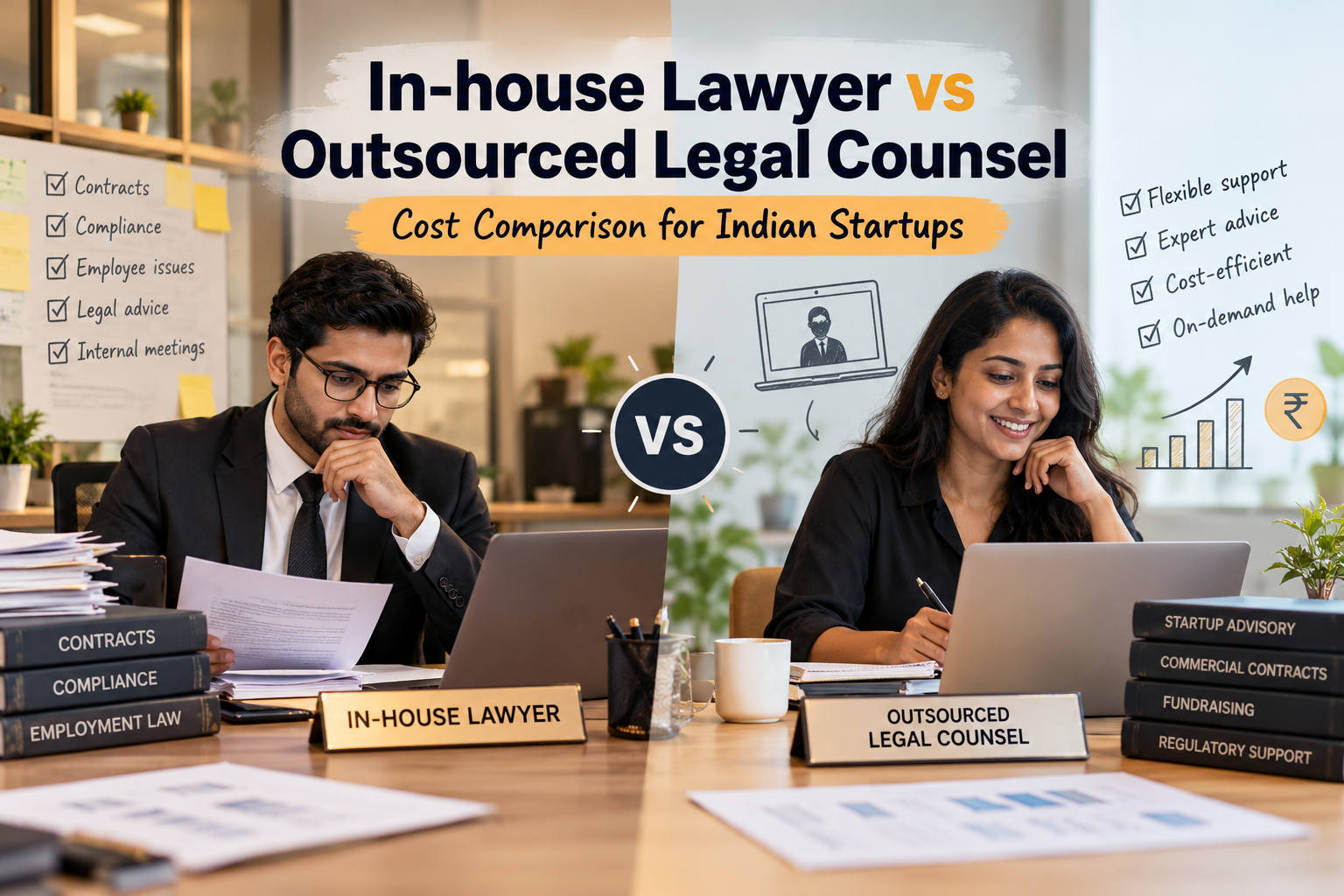
Is outsourced legal counsel cheaper than hiring an in-house lawyer? For Indian startups, the answer is yes. If your company only needs advice a few times a month, hiring someone full-time can feel like a big expense for work that doesn’t happen every day.
Imagine you’ve recently started getting clients. Contracts are coming in. You’re hiring employees. Every now and then a legal question pops up that you just can’t answer on your own. You know you need a lawyer. You’re not sure if hiring one permanently is worth the cost.
That’s where a monthly legal retainer can come in handy. Instead of hiring a full-time lawyer, you can get regular legal support through outsourced legal counsel India services. This keeps your expenses more manageable and flexible.
Still, it’s not always true that outsourcing is cheaper. If your business deals with contracts, negotiations, and compliance issues every single day, then an in-house lawyer might actually be the better choice. It could save you time. Give you quicker access to legal help.
What’s the Difference Between an In-house Lawyer and Outsourced Counsel?
An in‑house lawyer is part of the company. The in‑house lawyer works with the company’s team, attends meetings, reviews contracts, and gradually becomes familiar with how the business operates.
If the sales manager has a question about a client agreement, the sales manager can discuss it directly with the team. When HR finds itself stuck with an employment issue, HR can reach out to someone who already knows the company’s policies.
That familiarity can be valuable, especially when legal questions arise every day.
Outsourced counsel works differently. Instead of employing a lawyer, the company engages an external professional or legal firm for a set of agreed services.
You might need help with:
- Reviewing client and vendor agreements.
- Preparing employment contracts.
- Understanding compliance requirements.
- Drafting founders’ or shareholders’ agreements.
- Handling legal notices.
- Getting advice before signing an important deal.
Some businesses prefer working with a fractional legal consultant India service. This usually means having access to a legal professional on an ongoing, part-time basis rather than hiring someone permanently.
The main difference isn’t necessarily the quality of advice. It’s the working arrangement, availability, and cost.
What Are You Actually Paying For?
When comparing legal support, most founders look at two numbers: the salary of an in-house lawyer and the monthly fee charged by an external legal consultant.
That’s a reasonable starting point, but it doesn’t tell the whole story.
The actual cost of an in-house lawyer
The in-house counsel cost India depends on experience, location, and the type of legal work involved.
A lawyer handling routine contracts may have different salary expectations from someone experienced in fundraising, corporate governance, or regulatory matters.
And salary isn’t the only expense. You’ll also need to consider:
- Recruitment and onboarding.
- Applicable employee benefits and statutory contributions.
- Work equipment and software.
- Paid leave and other employment-related expenses.
- Training and professional development.
There’s also the question of specialist work.
Suppose your in-house lawyer handles commercial contracts but your company becomes involved in a complicated intellectual property dispute. You may still need to hire an external specialist.
So, employing a lawyer doesn’t necessarily mean you’ll never pay another legal bill.
How outsourced legal counsel India fees work
With outsourcing, you generally have more choice in how you pay.
Some lawyers charge by the hour. Others quote a fixed fee for a particular assignment. If you need regular support, you can agree on a monthly retainer.
For example, a startup that frequently reviews contracts but rarely faces major legal issues might prefer a monthly legal retainer instead of paying separately for every consultation.
But there’s something you should check before signing.
What exactly does that monthly fee include?
One service provider might offer check-ins and contract evaluations while another might only work on a certain number of papers. Court cases, tasks and complicated deals might have additional fees.
A low retainer fee isn’t particularly helpful if most of your legal work ends up being billed separately.
Comparing the Costs
Let’s put some numbers to it.
Imagine a startup with 20 employees. The company needs help with employment agreements, client contracts, and occasional compliance questions.
The founders are deciding whether to hire a lawyer or work with an external legal consultant.
These figures are hypothetical examples for comparison, not current market quotations.
Option 1: Hiring a lawyer
Suppose the company estimates the following first-year expenses:
- Annual compensation: ₹12,00,000
- Additional employment expenses: ₹1,80,000
- Recruitment, equipment, and training: ₹70,000
That brings the estimated first-year cost to ₹14,50,000.
The advantage is having someone available internally during working hours. But even if there are only a handful of contracts to review that month, the employment cost remains the same.
Option 2: Outsourcing legal work
Now suppose an external legal professional offers a retainer of ₹50,000 per month.
The company budgets:
- Annual retainer: ₹6,00,000
- Additional legal assignments: ₹1,50,000
The estimated annual expense comes to ₹7,50,000.
In this example, outsourcing costs ₹7 lakh less over the first year, a difference of roughly 48%.
That’s quite a saving for a small business.
But there’s a catch. This comparison only works if the retainer covers most of the company’s actual legal needs. If additional work keeps coming up, the final bill could be higher. Applicable taxes would also need to be considered when comparing real proposals.
That’s why founders should look at their total annual legal expenses, not just the monthly quote.
Legal Retainer vs Full-time Lawyer: How Much Support Do You Need?
Here’s where the decision gets interesting.
A startup might spend less on outsourced legal services, but what if its team regularly has to wait for contract reviews?
Delays can affect negotiations, client onboarding, and other business activities.
On the other hand, hiring someone full-time for just a few hours of legal work every week may not be a sensible use of money.
When an in-house lawyer makes sense
Think about a company that’s constantly negotiating contracts, dealing with vendors, and answering legal questions from different departments.
Having an internal lawyer can make things easier because they already know the people, processes, and business priorities.
An in-house lawyer may be worth considering when:
- Contracts need reviewing almost every day.
- Legal questions regularly come from multiple departments.
- The company operates in a highly regulated sector.
- Management needs frequent legal input.
- Delays in legal review are affecting business operations.
The biggest benefit is having someone involved in the business rather than calling an external professional every time something comes up.
When outsourced counsel works better
Now imagine a smaller company that signs a few agreements each month and occasionally needs advice about employment matters or compliance.
Hiring someone full-time might be more than the business needs.
In that situation, a fractional general counsel India arrangement could be useful. It allows the company to receive ongoing legal guidance without employing a permanent senior legal professional.
The important part is agreeing on availability.
If you regularly need urgent advice, make sure the external lawyer can provide it within a reasonable timeframe. Otherwise, the lower cost may come with delays your business can’t afford.
What Happens When Your Lawyer Isn’t Available?
Legal support isn’t only about getting contracts reviewed. It’s also about knowing who will handle things when something unexpected happens.
Suppose your company receives a legal notice just as your in-house lawyer goes on leave. Or your external consultant is busy with another client’s urgent matter.
Who’s responsible for responding?
These situations are easier to manage when responsibilities are clear from the beginning.
The challenges with an in-house lawyer
Having a dedicated employee offers continuity, but depending entirely on one person has its drawbacks.
For example:
- Work may slow down during leave or illness.
- Resignation can leave pending matters unfinished.
- Specialist legal issues may require outside help.
- A growing workload may become too much for one lawyer.
The challenges with outsourcing
External counsel has a different set of limitations.
You may face:
- Longer response times than expected.
- Additional fees for work outside the agreement.
- Less familiarity with internal company processes.
- Confusion about deadlines or responsibilities.
- Difficulties transferring documents when changing providers.
None of these problems is unavoidable.
A clearly written engagement agreement, organised records, and one internal person responsible for coordinating legal matters can make a considerable difference.
Which Option Fits Your Startup?
Rather than deciding based on price alone, look at how legal work actually happens in your company.
Outsourcing may suit your business if:
- You’re still building your startup.
- Legal work comes up occasionally.
- Most requirements involve contracts and routine advice.
- You don’t have the budget for a permanent lawyer.
- You want flexibility as your business grows.
For these businesses, outsourced legal counsel India can be a practical way to get professional advice without committing to a full-time legal department.
An in-house lawyer may be better if:
- Your company handles legal matters almost daily.
- Contracts and negotiations are frequent.
- Several teams regularly need legal advice.
- Your industry has complex regulatory requirements.
- Legal support needs to be closely involved in management decisions.
Can you use both?
Absolutely. A company might have one in-house lawyer handling routine agreements while engaging external lawyers for litigation, fundraising, or specialist regulatory work.
You don’t need to build a large internal legal department to handle every possible legal issue.
For some growing businesses, combining internal support with outside expertise may be the most practical arrangement.
What Should You Ask Before Hiring Legal Counsel?
Before choosing either option, spend a little time understanding what your business really needs.
Start with these questions:
- How many agreements do we review in an average month?
- Do legal questions come up every day or only occasionally?
- Are we planning fundraising or expansion?
- Do we need legal support urgently or can most work be scheduled?
- How much did we spend on legal services last year?
- Which matters require specialist expertise?
If you’re considering outsourcing, ask the provider what their fee covers, how quickly they respond, and what happens when work falls outside the agreed scope.
Also, pay attention to communication.
A good legal professional should be able to explain why a contract clause matters, what risks it creates, and what options you have. You shouldn’t need another lawyer just to understand the first lawyer’s advice.
Frequently Asked Questions
It usually is, for companies that don’t have a lot of legal needs. Hiring help can lower the cost of having full-time employees. But the total cost depends on the agreement, how work there is and any extra things that are needed.
A legal retainer is an agreement to receive specified services from an external legal professional, usually for a recurring fee. A full-time lawyer is employed directly by the company and works as part of its internal team.
When legal work happens enough to need regular focus, it’s worth considering. If contracts, negotiations, and compliance tasks take up a lot of time each week, bringing someone on board internally could make sense.
Yes, external lawyers can advise on compliance requirements and assist with documentation. However, the company remains responsible for meeting its legal obligations, and some matters may require specialist advice.
Not always. Legal fights and going to court are usually billed on their own. Make sure to look at the contract to know what is included. The contract is important. Always check the agreement to know what is covered. The agreement is key. Always check the agreement to understand what’s covered.
Conclusion
When a startup needs help from time to time, outsourcing becomes a sensible choice to keep costs in check. A startup can use help to get advice without paying a full‑time salary. Legal help can grow as the startup grows or changes.
However, if legal questions arise each day, hiring legal retainer services for businesses may justify the investment. The correct choice depends on the workload, the budget, and on how legal support must be involved in the business.
Before signing a retainer or posting a job opening, review the work that the company actually handles. That review will reveal more than a simple comparison of two numbers on paper.
Leave a Reply