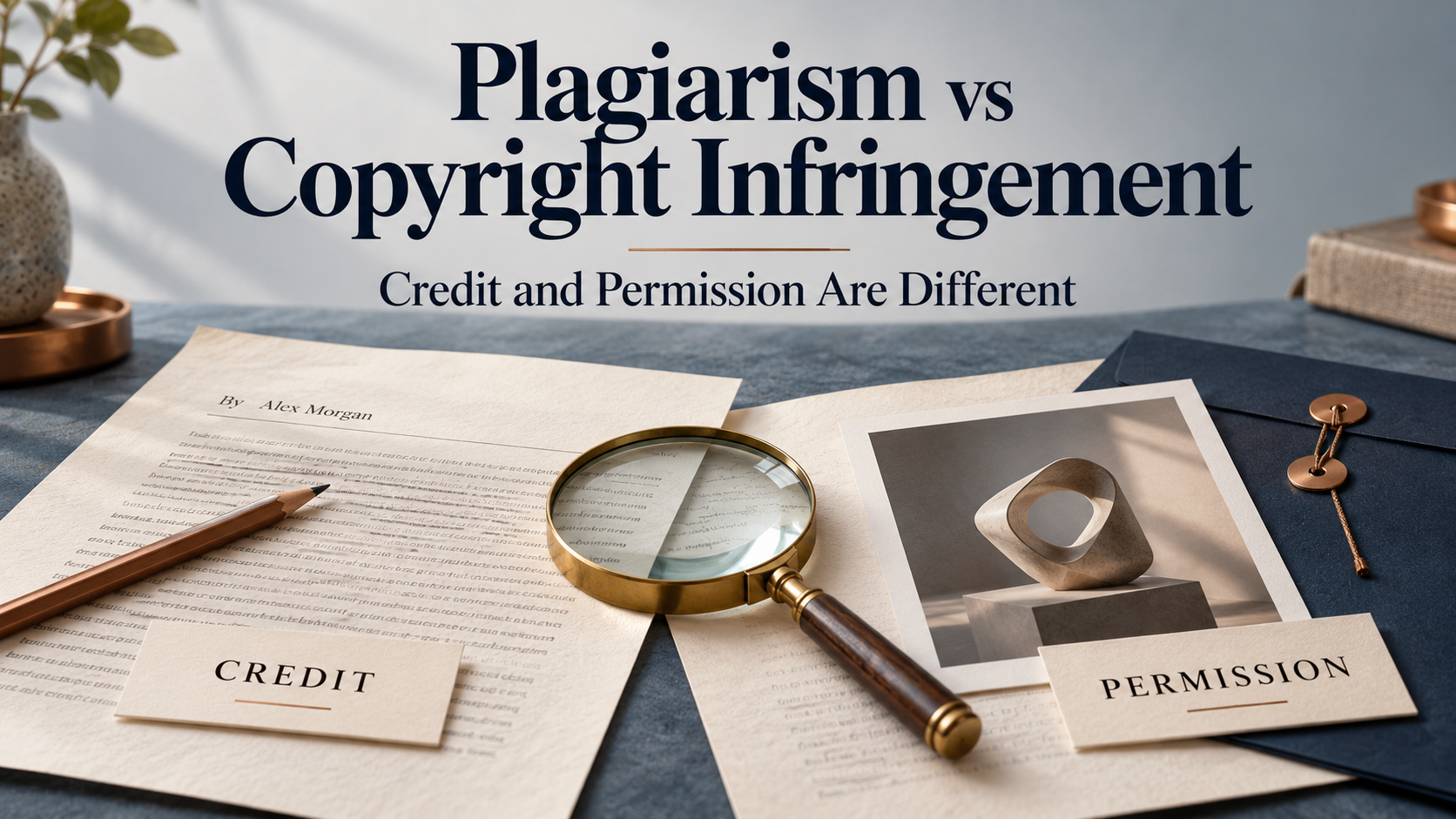
You find a photograph that fits your blog perfectly. You download it, add the photographer’s name and publish the article. You’ve given credit, so you feel comfortable using it. A copyright infringement lawyer would ask another question: did the photographer permit that use?
That question explains much of the confusion around plagiarism vs copyright infringement. One concerns how you represent someone’s contribution. The other concerns whether you have the right to use their work.
Writers, students, agencies and businesses encounter both issues. Understanding the distinction helps you make better choices before publishing—and respond more carefully when someone copies your work.
Is Plagiarism the Same as Copyright Infringement?
No. Plagiarism generally means presenting someone else’s words, ideas or work as your own without appropriate acknowledgement. Copyright infringement involves exercising a right that copyright law reserves to the rights holder, without permission or an applicable exception.
The same conduct can raise both concerns. Either issue can arise on its own.
Consider these situations:
- You copy a protected article and publish it under your name. Both issues may arise.
- You credit a photographer but use their image without the necessary permission. Copyright concerns may remain.
- You say you wrote a poem that is no longer protected by copyright. This can be considered stealing someone Work even if the original poem is not protected by copyright.
Ask yourself two questions: Have I explained where this came from? Do I have the right to use it this way?
Definitions: What Each Term Means
People often use these terms interchangeably when discussing copied content. The distinction matters because each concern calls for a different assessment.
Plagiarism Concerns Who Gets the Credit
Plagiarism misrepresents the source of a contribution. Someone might take paragraphs without using quotation marks. They could reword someone Ideas without giving credit. They might hand in someone elses report as if it was their own work.
The setting shapes the standards. Universities, publishers and professional organisations may follow different citation rules. Readers still need to understand which contributions come from you and which come from someone else.
Changing a handful of words doesn’t necessarily solve the problem. If another person developed the argument or explanation you rely on, acknowledge that contribution appropriately.
Copyright Infringement Concerns the Right to Use
Copyright protects qualifying expression rather than ideas alone. An infringement assessment examines the work, ownership, rights, licence terms and actual use. Someone can acknowledge the creator accurately and still use material beyond the permission they hold.
That distinction turns the idea of plagiarism and the idea of copyright infringement into matters that anyone who writes and shares content must worry about. A credit line tackles a question that’s not the same, as the question tackled by a licence.
Where the Two Overlap
Imagine an agency takes a photographer’s protected image, removes the photographer’s name and presents it as work from its own creative team.
The photographer may object to the copying and the authorship claim. Those concerns require separate review.
Change one detail: the agency keeps the photographer’s name but never obtains permission for the campaign. The attribution may identify the creator honestly, yet the agency may still infringe copyright.
Plagiarism vs Copyright Infringement: Credit Does Not Replace Permission
A credit tells readers where material came from. A licence tells you what you may do with it.
A photographer might permit an image in an editorial article without allowing advertising use. A licence might cover commercial use while requiring a specific credit. Check:
- Who owns the relevant rights?
- Does copyright still protect the material?
- What permission do you hold?
- Does it cover your platform and purpose?
- Does it restrict editing or reuse?
- Does it require attribution?
- Could a statutory exception apply?
A download button doesn’t answer these questions. Neither does a caption saying “credit to the owner.”
Is Plagiarism Illegal in India?
People searching “is plagiarism illegal in India” often expect a simple yes or no. The facts need more attention than that.
Plagiarism does not describe one offence that automatically establishes criminal liability. The conduct may involve copyright infringement, an author’s special rights, contractual duties or academic misconduct.
Section 57 of the Copyright Act recognises an author’s right to claim authorship. Applicable academic-integrity frameworks, including the UGC’s plagiarism regulations, can lead to institutional consequences within their scope. A university finding and a copyright judgment address different questions.
When reviewing plagiarism vs copyright infringement, start with the conduct:
- What material did the person take?
- How did they present it?
- Did they need permission?
- What permission existed?
- Which institutional or legal rules apply?
A similarity report can flag passages for review. It cannot settle every legal question or explain the full context.
Remedies: How to Respond When Someone Copies Your Work
Seeing your work listed under someone elses name can make you feel angry and want to talk to them away. Make sure to keep proof of your work before you send any message. Keep:
- Your original files and drafts.
- Publication dates and links.
- Relevant agreements.
- Screenshots of the challenged material.
- The publisher’s or account holder’s details.
- Dates when you captured the evidence.
Identify the issue you want to address and the outcome you need.
Responding to Plagiarism
Depending on the setting, you might:
- Ask for accurate attribution.
- Request a correction.
- Contact an editor or publisher.
- Follow an institution’s complaint procedure.
- Seek withdrawal or retraction.
- Review contractual remedies.
Make the complaint clear. Point out the material that was used. Explain how the other person said it came from a place than it really did. Stay away, from claims that are not backed up by proof.
Responding to Copyright Infringement
Section 55 provides civil remedies that can include injunctions, damages or accounts, subject to the facts and statutory conditions.
Criminal provisions may apply where the conduct satisfies their requirements, including the necessary knowledge. Not every copying complaint supports criminal action.
Possible responses include a supported notice, negotiation, an available platform complaint or legal proceedings. Review ownership, permission and exceptions before choosing a route.
Examples From Everyday Content Work
These examples illustrate the distinction. Individual disputes need their own assessment.
A Business Credits a Photographer in an Advertisement
A business downloads a photograph, names the photographer and uses the image in an advertisement.
The credit doesn’t establish permission. The business needs to check whether its licence covers that use or another legal basis applies.
Someone Claims an Old Poem as Their Own
A person publishes an out-of-copyright poem with their own byline. That can amount to plagiarism. Copyright in the original poem may have expired. A modern translation or illustration may carry separate protection, so check exactly what the person copied.
A Company Rewrites a Competitor’s Article Lightly
A company copies a substantial part of a protected article, swaps a few words and adds its own byline.
Both concerns may arise. Minor wording changes don’t automatically create an independent work or resolve unauthorised copying.
A Reviewer Quotes an Extract
A reviewer quotes a passage, identifies the source and discusses the writing. India’s fair-dealing provision includes criticism and review. Fairness depends on the circumstances; no universal word count makes every quotation lawful.
These situations show why a credit check cannot settle plagiarism vs copyright infringement on its own.
A Checklist Before You Publish
Keep a source record while researching. It saves time when someone asks where an image came from or what permission covers a passage.
Before publication, check:
- Have you marked quotations clearly?
- Have you acknowledged sources appropriately?
- Do you hold the necessary permissions?
- Does the licence cover the intended use?
- Have you checked third-party music, images and footage?
- Have you assessed any exception you plan to rely on?
Separate research notes from draft copy. A writer might accidentally include a reference passage, in the article especially when there is a lot of pressure to meet a deadline.
Ask freelancers and contributors to identify third-party material when they deliver work. Your team needs time to check it before publication.
Frequently Asked Questions
Not automatically. Paraphrasing without acknowledging the source can still amount to plagiarism. Copyright assessment examines whether someone has taken protected expression.
No universal percentage makes copying lawful. Academic similarity thresholds serve a different purpose; they don’t give you copyright permission.
A disclaimer doesn’t replace permission or establish an exception. Assess the actual use and the rights involved.
Copyright doesn’t protect an idea by itself. Confidentiality, contracts, patents or other obligations may affect what you can do. Academic and professional standards may require acknowledgement.
Deletion may stop continuing use. It doesn’t automatically resolve earlier liability or other claims. Preserve records and review the next step.
Conclusion
Understanding plagiarism, versus copyright infringement means checking attribution and permission separately. Plagiarism is copying words without giving credit. Copyright infringement is using someone Work without permission. Each of these needs its check. Explain borrowed contributions honestly, read licence conditions and keep source records. If someone copies your work—or you need advice before using another person’s material—a copyright infringement lawyer in Delhi can help assess the facts and the appropriate response.
Leave a Reply