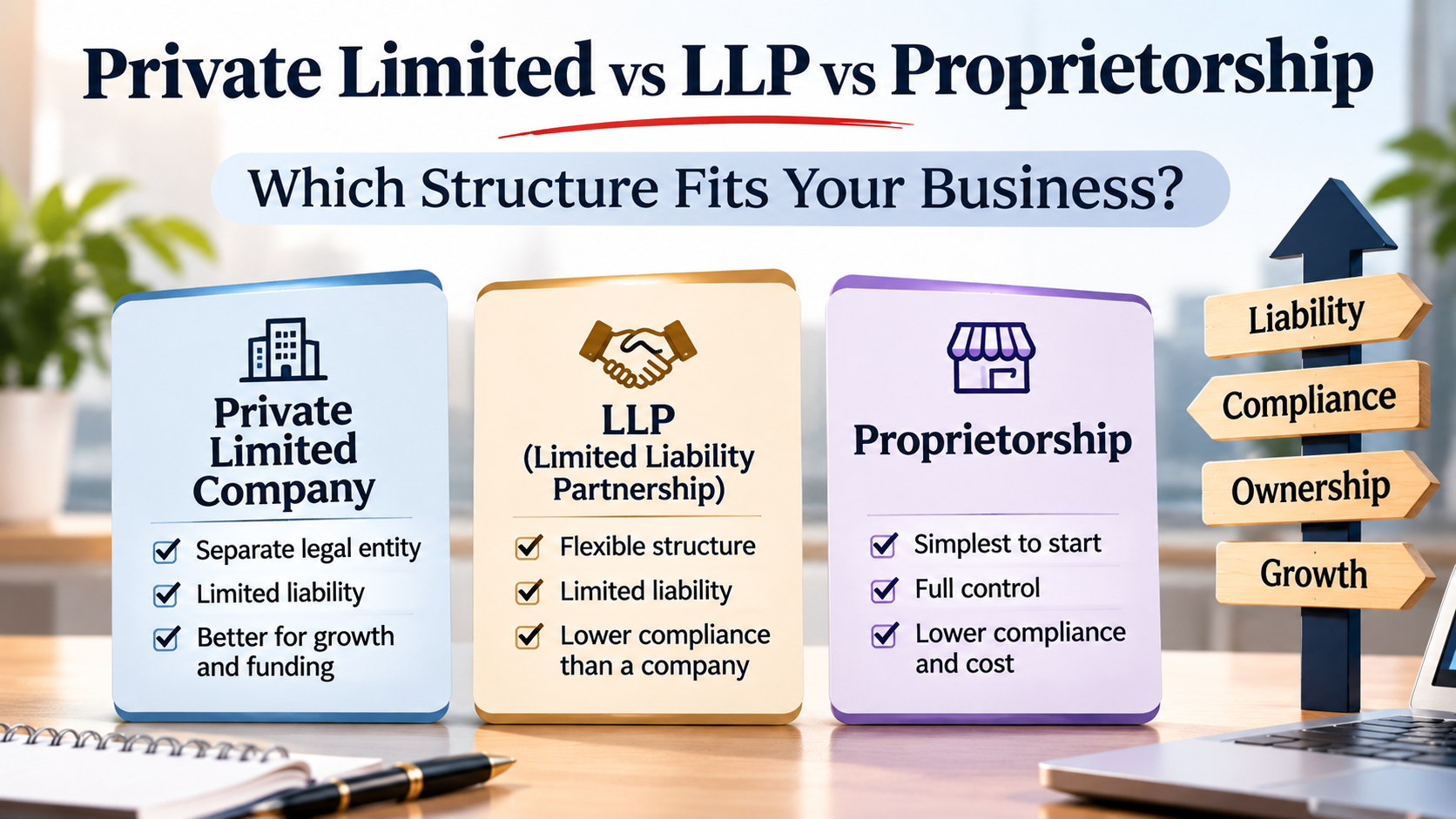
Setting up a business can be an exciting process. However, you may become confused as to what structure you should choose. You may have a brilliant idea, a few customers and a well-planned business, but you may be unsure as to whether you should form a company. The private limited vs LLP comparison becomes important when you consider personal liability, taxes, compliance and future growth. A structure that works for a freelance consultant may not suit a startup planning to raise investment. Before completing your registration, speaking with a law firm in Delhi NCR can help you understand the legal implications.
Which Business Structure Should I Choose in India?
Your choice will depend on what you want to do with your business in terms of ownership, risks, compliance costs and future funding.
Typically:
- Private Limited Company – If you’re setting up a start-up and want to raise equity investment, issue shares or grow your business significantly.
- Limited Liability Partnership – Often a good option for professional services businesses and those wanting limited liability.
- Sole Proprietorship – Usually a good option for sole traders who wish to start a small business with little capital, and limited risk.
There is no one-size fits all, so you should consider your goals for the next few years.
Understanding the Different Business Structures
Before you start comparing the cost of registering and compliance, it’s helpful to understand how each business structure works.
Private Limited Company
A private limited company is a legal entity that can be incorporated under the Companies Act, 2013. It can own assets, enter into contracts and raise capital by issuing shares.
Shareholders typically have limited liability, meaning it can be a good option for businesses looking to grow significantly.
Limited Liability Partnership
An LLP is a hybrid of a partnership and a legal entity. Partners can manage their business in line with their LLP agreement. Partners also typically have limited liability.
This is often a popular option for consultants, professional businesses and service-based businesses.
Sole Proprietorship
A sole proprietorship is owned and run by one person. As there is no legal entity, this can make it simple to run. However, the proprietor will have personal liability.
Private Limited Vs LLP Vs Proprietorship – Comparison
Now you understand some of the differences between a Private Limited and LLP, you can make an informed decision.
| Factor | Private Limited | LLP | Proprietorship |
| Legal Entity | Legal Entity | Legal Entity | No Legal Entity |
| Ownership | Shareholders | Partners | 1 Proprietor |
| Liability | Typically Limited | Typically Limited | Unlimited |
| Minimum Number of People | 2 Shareholders | 2 Partners | 1 |
| Compliance | High | Medium | Typically Low |
| Equity Funding | More Suitable | Can’t issue company shares | Can’t issue company shares |
| Tax | Company Taxation | LLP Taxation | Individual Taxation |
| Best For | Growth-Oriented Start-Ups | Professional/Service Businesses | Small Individual Businesses |
This is just a general guide to give you an insight into the different structures. You should consider your business and any regulations.
Liability: Understanding Personal Financial Risk
Liability is one of the most important factors when selecting a business structure India entrepreneurs can use. Imagine your business owes a large amount of money. Who will be liable?
In a proprietorship, as the business and owner are the same thing, you could be liable for personal assets. Both private limited companies and LLPs typically have limited liability, separating personal assets from business liabilities.
However, there are situations where you could still be personally liable. For example, if you’re providing personal guarantees, fraudulent activity or certain statutory obligations.
Compliance: Registration and Annual Requirements
This is a big factor to consider when choosing between a Private Limited or LLP. Some structures will require you to complete more reporting and documentation.
Private Limited Company Compliance
Private limited companies typically have more formalities to complete. This will typically include:
- Keeping statutory registers.
- Filing annual returns.
- Producing financial statements.
- Holding required board meetings.
- Meeting audit requirements.
- Keeping a record of directors and shareholders.
This can take up a lot of your time.
LLP and Proprietorship Compliance
LLPs typically have less formalities compared to a private limited company. They will however have statutory requirements to file and keep records.
A proprietorship will typically have less formalities in terms of the entity. However, there may be requirements to comply with GST, Income Tax, Labour and Industry specific requirements.
Businesses can seek company secretary support to understand relevant corporate compliance obligations.
Funding: Choosing a Structure That Supports Growth
Depending on your funding requirements, this can greatly affect what structure you should choose.
For example, if you’re starting a tech business and want to approach venture capital investors in the next 2 years, you may find a private limited company is a better option. This is because you can issue shares.
An LLP can receive contributions from partners and other authorised funding. However, you can’t issue equity shares like a company.
A proprietorship may rely on the owner’s resources, business loans or other funding sources. If you’re looking to raise external equity investment, then you should consider the structure.
Tax Considerations
Whilst taxes are an important consideration, choosing a structure based solely on the tax benefits can be misleading. Each structure will have different tax considerations.
Private Limited Company Tax
Domestic companies may pay taxes in accordance with the relevant tax regime. This could include concessional regimes if the requirements are met.
There may also be considerations around dividend tax and other shareholder implications.
LLP Tax
LLPs typically pay tax in accordance with the tax regime for partnership firms.
You’ll need to consider how you’re remunerating your partners, interest and how profits are distributed in accordance with the relevant income tax legislation.
Proprietorship Tax
Income will typically be taxed in the individual’s taxable income. This will depend on the tax slabs, deductions and tax regimes applicable. A tax professional can help you understand the actual implications.
Ownership and Decision-Making
Ownership can impact how quickly decisions can be made. With a proprietor, the owner will typically make decisions on their own.
With an LLP, the partners can agree on how they want to manage their business and how profits will be shared in their LLP agreement.
A Private Limited Company, can help the directors and shareholders manage the business. Decisions will be made in accordance with company law and the constitutional documents.
If you have more than one founder, it’s important to have clear ownership in place to avoid any disputes in the future.
Business Registration and Setup Costs
For company registration Delhi businesses may need to consider some points, when registering a company in Delhi you may need to pay:
- Fees for filing with the government.
- Stamp Duty.
- Digital Signatures.
- Professional Incorporation Fees.
- Registered Office Documentation.
- Compliance costs after registration.
A proprietorship may be cheaper to set up initially as there is no incorporation. However, you may need to register your business. Consider what the ongoing costs will be.
Common Mistakes
Many entrepreneurs look at what their friends or competitors have registered and decide to go for the same structure. This can cause issues in the future.
Common mistakes include:
- Not considering personal liability with a proprietorship.
- Not budgeting for compliance costs with a company.
- Choosing an LLP when planning to raise equity.
- Not considering tax implications.
- Not documenting founder responsibilities.
- Thinking you can easily change your structure in the future.
For example, changing from a proprietorship to a company could mean you need to transfer your assets, contracts and registrations. Planning ahead can help you avoid this.
Tips to Help You Decide
Consider what you need now and what you want for the future.
- Will you be running your business alone or with partners?
- How much risk are you willing to take financially?
- Are you planning to raise equity?
- Can you afford recurring compliance costs?
- Will you be employing staff or entering new markets?
- What ownership will you require?
If you’re starting a small business on your own, a proprietorship may be a suitable choice. For those planning to run a professional partnership, an LLP offers a balance of flexibility and limited liability. However, if your goal is to raise investment, expand your business, and establish a structured ownership model, a private limited company may be a better option.
FAQs:
It depends on your circumstances. An LLP may be a good option for professional businesses whereas a private limited is often more suitable for raising equity and growth orientated start-ups.
Yes, a sole proprietor can employ staff. They must comply with the relevant employment, tax and labour laws.
A proprietorship typically has less formalities. An LLP typically has less corporate compliance than a private limited.
Yes, an LLP can receive authorised contributions from partners and other funding. However, unlike a private limited, they can’t issue equity shares.
A business can be restructured into a company. Appropriate incorporation and transfer processes can be put in place.
A private limited is often preferred for start-ups looking to raise equity. However, a business should consider what they want in terms of ownership, funding and running their business.
Conclusion
There are many factors to consider when deciding between a private limited, LLP and proprietorship. Liability, compliance, taxes and funding can all impact what’s best for your business. The private limited vs LLP decision becomes easier when you understand your long-term goals and the responsibilities attached to each option. Entrepreneurs looking to register or restructure can use professional legal services in Delhi to understand what requirements apply.
Leave a Reply