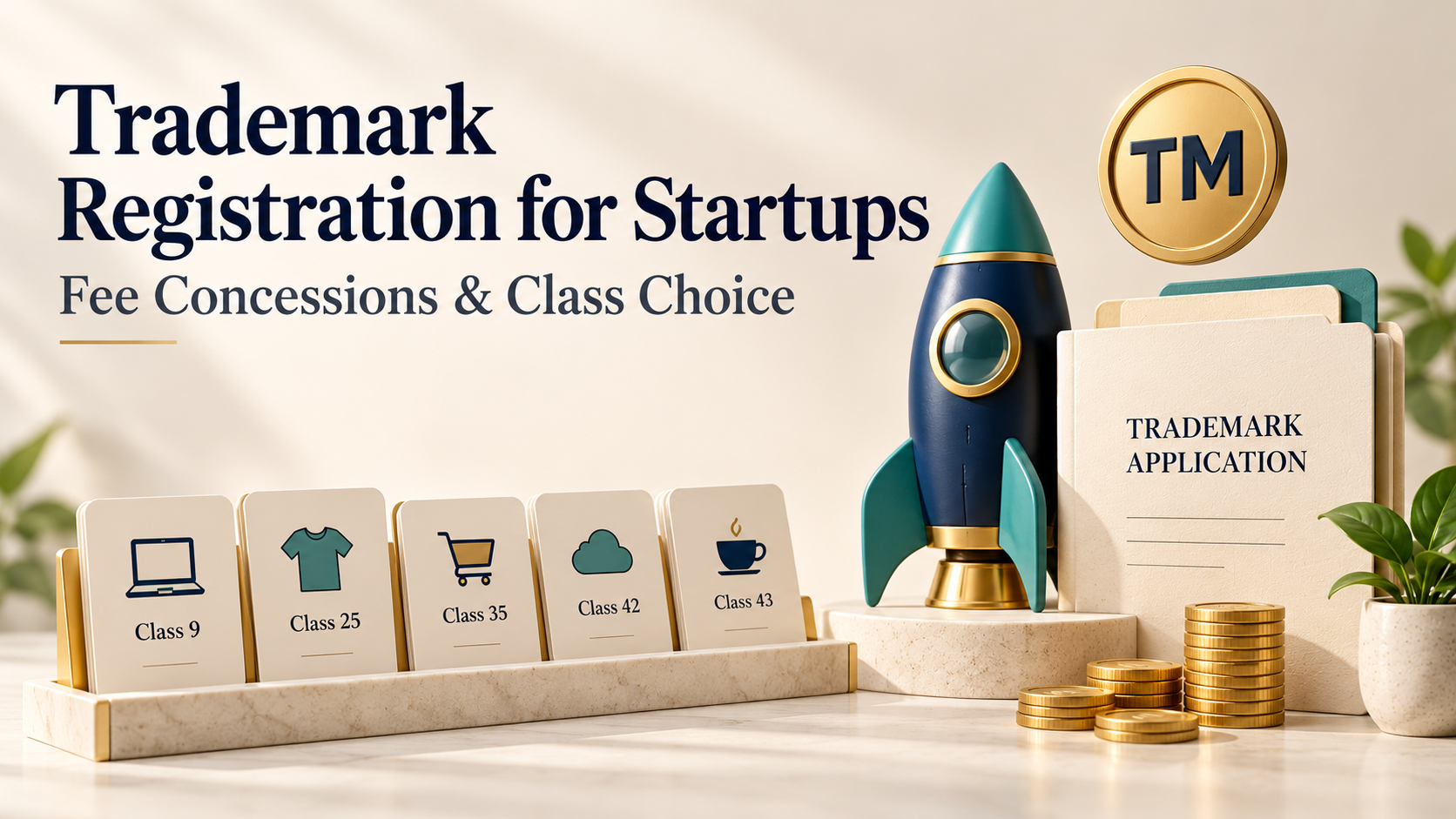
Choosing a brand name can be one of the fun parts of starting a business. You play around with spellings check if the domain is available and imagine how the logo will look on your product packaging. Trademark registration for startup businesses gets easier when you break it down.
First figure out who owns the brand. Then check if you’re eligible pick the coverage and figure out the cost. A concession might lower the filing cost. Picking the right kind of application is just as important, as paying the right fee.
Then you get to the trademark application. Suddenly face questions you never thought about. Does your business qualify for the startup fee? Which class should you pick for your products? Should you register the name, the logo or both?
Do Startups Pay Less for Trademark Registration?
Yes. Eligible startups pay a lower government application fee. For electronic filing of Form TM-A, the fee is ₹4,500 per mark, per class for individuals, startups and small enterprises, compared with ₹9,000 for other applicants.
For filing the corresponding amounts are ₹5,000 and ₹10,000. These fees are government application fees, not a price, for professional assistance or later proceedings.
However being newly incorporated does not automatically make a company eligible to be considered a startup.
If you need trademark filing support in Delhi please share ownership details, recognition documents and a list of your products before requesting a quote. These details impact both the fee category and the filing strategy.
Fee Concession: What You Actually Save
The lower rate can make early brand protection more affordable. Still, it helps to understand exactly where the saving applies.
The Startup India trademark fee concession concerns the relevant official application charge. It does not automatically halve every expense connected with the matter.
Your overall budget may include:
- Availability searches and assessment.
- Application preparation.
- Government fees.
- Additional marks or classes.
- Replies to examination objections.
- Hearings or opposition proceedings.
Ask which stages a professional quotation includes. A low initial price can look different once follow-up work is added.
Calculate the Cost Per Mark and Class
Suppose an eligible startup electronically files one mark in two classes. At ₹4,500 per class, the government application fee would total ₹9,000.
If it separately files a word mark and a logo mark in those same two classes, the corresponding total would be ₹18,000.
These examples assume the stated eligibility and fee structure. Professional charges and other work remain separate.
The calculation explains why a multi-class application is not a way to pay once for unlimited coverage. The official schedule charges by mark and class.
Proof: Documents That Support Startup Eligibility
Founders sometimes assume a company registration certificate is enough to claim the startup rate. It establishes incorporation, but startup recognition is a separate matter.
The Trade Marks Rules define an Indian startup by reference to recognition by the competent authority under the Startup India initiative. IP India’s guidance identifies supporting government certificates, including DPIIT recognition, for the relevant concession claim.
Prepare the applicable records, which may include:
- DPIIT recognition certificate.
- Incorporation or entity-registration details.
- Applicant name and address.
- Relevant authorisation documents.
- Details explaining any name change.
The phrase DPIIT trademark rebate can sound like money returned after payment. Here, it is more useful to think of a lower eligible application fee. Do not assume a later refund will automatically follow if you pay under another category.
Match the Certificate to the Applicant
Check whether the recognised entity is the applicant claiming the concession.
If the startup owns the brand, filing in a founder’s personal name simply because it seems convenient may create ownership questions later.
Individuals also have a lower-fee category, but fee savings should not decide ownership.
Resolve who should hold the mark before filing. An accurate ownership record is worth more than avoiding a short discussion now.
Class Choice: Cover What Your Business Actually Does
Class selection is where trademark registration for startup businesses needs commercial detail.
“An online brand” does not explain enough. Are you selling clothing, cosmetics, downloadable software or training services?
Trademark classification divides goods and services into 45 classes. Classes 1–34 cover goods, while Classes 35–45 cover services. The description of goods or services within the application also matters.
Before discussing classes, prepare a plain-English list:
- What do you sell today?
- What appears under the brand?
- Do you supply goods, services or both?
- Which launches are genuinely planned?
- Does the name identify a product or a wider platform?
That list gives your adviser something concrete to assess.
Products and Retail Services Are Different
Selling through a website does not automatically mean one online-retail class protects every product.
A mark used on physical goods and a mark used for retail services raise different coverage questions.
Likewise, a software business may provide downloadable software, hosted software services or both. The words “technology startup” do not settle the classification.
Explain what the customer receives and how the brand is used. Avoid selecting a class solely because another company chose it.
Plan for Realistic Expansion
You do not need to file across every imaginable business activity. At the same time, choosing only the cheapest-looking option can leave important offerings outside the intended coverage.
Separate your plans into:
- Existing products and services.
- Confirmed upcoming launches.
- Ideas that remain speculative.
Revisit the position when the business changes. A new product line may need further assessment rather than an assumption that the original filing covers it.
Name vs Logo: What Should You File First?
This question usually arrives with a budget constraint: “Can we start with one?”
A word mark focuses on the name as filed. A logo application concerns the particular visual representation, with its scope assessed accordingly.
If your name is central to customer recognition but the logo is still changing, a word-mark application may deserve early consideration. If the visual identity is commercially important, assess that too.
Consider:
- How customers recognise the brand.
- Whether the name is distinctive.
- Whether the logo is final.
- What the search reveals.
- Available filing funds.
- The goods and services involved.
A logo application should not be assumed to provide unrestricted rights in every word it contains.
For trademark registration for startup founders, the sensible choice follows the brand and legal assessment. It should not come from a blanket rule that names or logos are always better.
Common Mistakes in Trademark Registration for Startup Businesses
Several avoidable assumptions can complicate an application.
Assuming Recognition Guarantees Registration
DPIIT recognition supports the relevant eligibility claim. It does not establish that your chosen trademark is registrable.
The mark still needs assessment, and the Registry examines the application.
Searching Only for Identical Spellings
A search should consider relevant similarities, including pronunciation and related goods or services.
Changing one letter may do little if customers would say both names the same way.
Claiming an Unsupported Use Date
Applications may be based on proposed use or prior use. Where prior use is claimed, the official workflow calls for the relevant user affidavit and supporting material.
Do not use incorporation as a substitute for evidence of trademark use.
Forgetting the Application After Submission
Keep track of examination, correspondence and deadlines.
An application number confirms filing. It does not mean the registration process is complete.
A Practical Filing Checklist
Before proceeding, confirm:
- The correct owner and applicant.
- The proposed name or logo.
- Search findings and identified concerns.
- Relevant goods and services.
- Suitable classes and descriptions.
- Evidence supporting the fee category.
- Accurate use details.
- Included professional work and exclusions.
- Who will monitor the application.
If brand questions arise alongside supplier, freelancer and customer agreements, a fractional legal consultant may help coordinate recurring legal work within an agreed scope.
Ask whether searches, filings and specialist proceedings are included or separately charged.
Frequently Asked Questions
You may independently qualify as an individual or eligible small enterprise. Check the correct category and evidence rather than assuming every business needs startup recognition.
No. The lower government application fee still applies. Professional charges and later work may also be payable.
Yes. A proposed-to-be-used application is possible. Assess the owner, mark and coverage before submission.
No. Coverage depends on the goods or services specified and the applicable legal scope. Different offerings can require additional classes.
Assess timing carefully. Recognition, ownership, alternative eligibility and naming risks all matter. Do not delay automatically or assume recognition pending equals eligibility confirmed.
Conclusion
Registration of trademarks for start-up business is not only about getting some concession. You should determine whether you are eligible for registration, identify the owner and select classes based on your services/products. Further, you should think about how the name and logo would suit your needs regarding protection. All these will help you plan financially and develop your brand effectively.
Leave a Reply